By: Tessa R. Salazar
Philippine Daily Inquirer
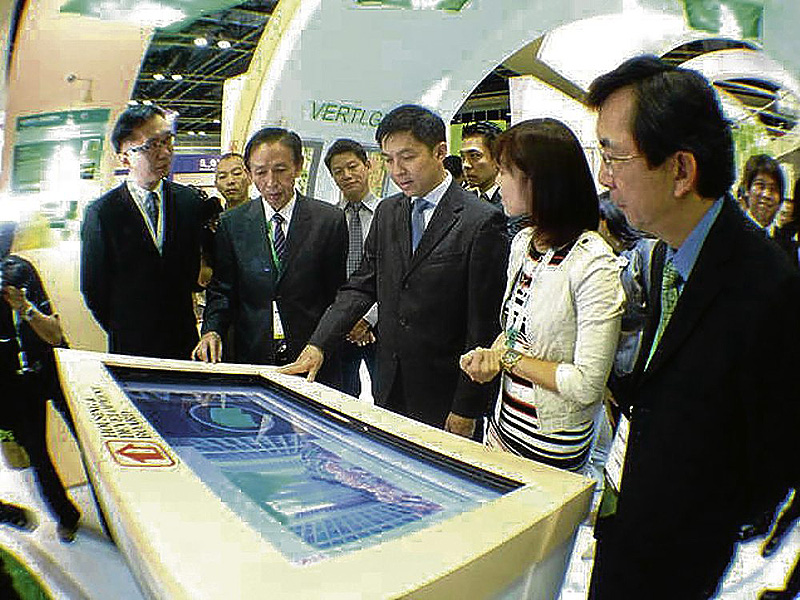
PROUDLY GREEN. Tan Chuan Jin, Minister of State for national development and manpower, is flanked by several green proponents. Singapore was ranked first among major cities in Asia Pacific for its environmentally sustainable building policies. Photo by Tessa R. Salazar
SINGAPORE—One color has been changing the way buildings and their components are now being made. It is, undoubtedly, green. But whereas before that color represented money and unbridled profits, and which had ironically cast a gray pall over the environment, today’s green stands for environmental sustainability.
And for just a conference and an exposition being held in the Lion City, this new “identity” assigned to the color which traces its roots to the Old English verb “growan” (to grow) can still also mean making a good, clean profit.
The International Green Building Conference 2011 and the green products exhibition Build Eco Xpo Asia were held at the Suntec Convention and Exhibition Center from Sept. 13 to 16. The conference gathered green building councils from various countries as well as an estimated 1,000 developers, architects, engineers and urban planners, while the exhibition had brought in 250 companies from 30 countries, attracting an estimated 8,000 visitors, and by the exhibit’s end, generated nearly $90 million in business transactions, as claimed by the expo organizers.
These events were held within the Singapore Green Building Week, and essentially offered to the public a new universe of environmentally sustainable building practices and technologies conceived by renowned industry think tanks, and made real by innovative organizations, engineers and industrialists from all over the world.
Ecologically responsible
The various symposiums on eco-cities, the tropical and subtropical green building councils’ alliance and sustainable construction pushed the envelope on ecologically responsible industry practices.
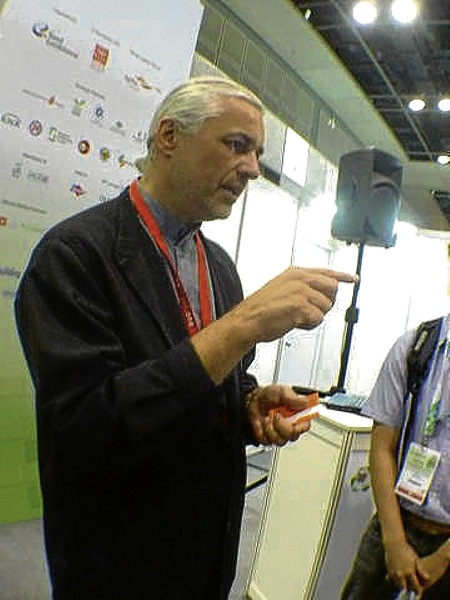
AUSTRIAN Fritz Oettl makes his home base for international consulting for sustainable architecture in Pakistan, Montenegro and Indonesia. Photo by Tessa R. Salazar
Christopher C. Dela Cruz, president of the Philippine Green Building Council and one of the speakers in the conference, told the Philippine media that PhilGBC’s mission in the building industry has primarily been to transform the market. “Berde is now positioned to be the rating system of choice of the property sector. More and more developers are using the scheme to illustrate leadership in environmental stewardship,” he said.
Berde, which stands for Building for Ecologically Responsive Design Excellence, is the first green building rating systemdesigned by Filipinos.
Dela Cruz also said the Apec-Asean joint workshop on green buildings, which was held here at the start of the week, “endeavors to harmonize standards in the region. We are working with the national Green Building Councils to create solutions in the property marketplace,” he said.
Dela Cruz’s counterpart Tai Lee Siang, the president of the Singapore Green Building Council, signed a strategic partnership with the Beijing Construction Decoration Association, Housing andDevelopment Board, the Building Research Institute, Jurong Town corporations and Singapore Business Federation.
Products of green minds
Simultaneously, at the expo, hundreds of enterprises proudly showed how green their minds were:
- One showcased its lightweight wall planting modules.
- Another displayed efficient hoisting machines with regenerative drives, thereby cutting energy consumption of building elevators by up to 50 percent.
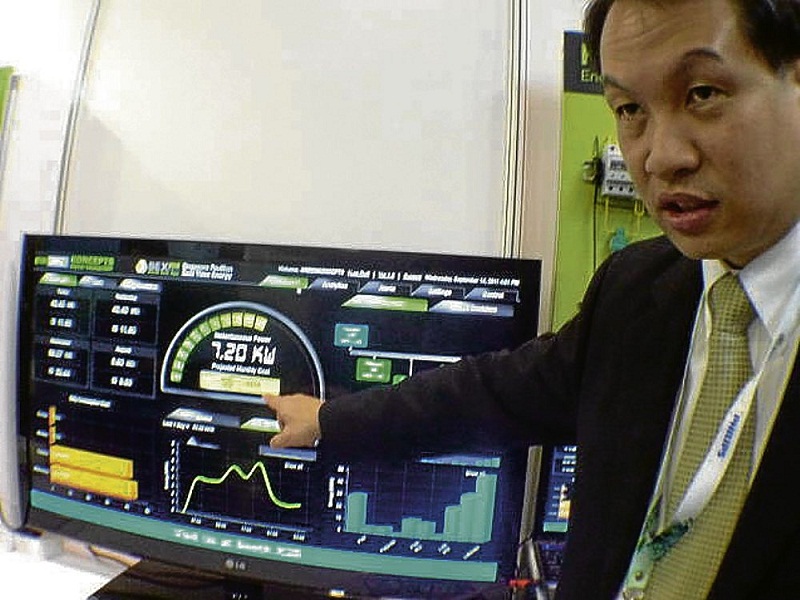
- A monitor showed real time consumption of electricity, water and gas.
- Another group showed its sustainable lighting technology to reduce energy consumption.
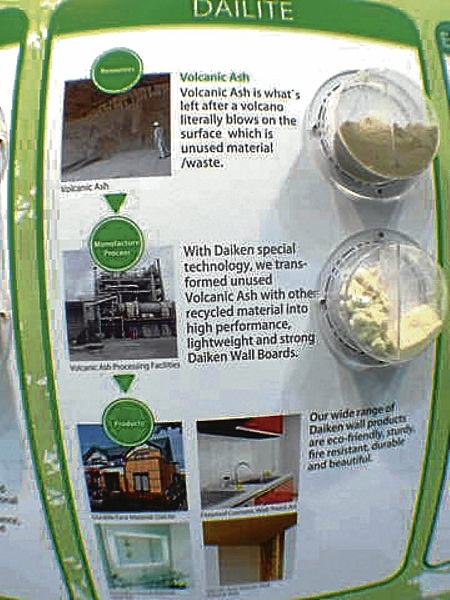
THE WALLBOARD is of volcanic ash. Photo by Tessa R. Salazar
- Another explained a new vertical farming solution with integrated biological lighting.
- A window film with high clarity and low light reflection that blocked harmful UV rays demonstrated the potential of nano-ceramic technology.
Architects like Fritz Oettl, known for the “green building” design of the Austrian Embassy in Jakarta, were seen hobnobbing with the audience, answering questions on sustainable architecture in hot and humid climates.
At the exhibit opening, BG (NS) Tan Chuan-Jin, Singapore’s Minister of State for National Development and Manpower, announced the Building Retrofit Energy-Efficiency Financing program that would provide loans to building owners and energy services companies to enable them to carry out energy retrofits on their buildings starting on Oct. 1.
Greening target
Singapore, a city-state of just under 700 square kilometers, has set an ambitious target of greening 80 percent of its buildings by 2030.
Since April 2008, the Building and Construction Authority (the government agency responsible for the built environment and green building policies in Singapore) had required new buildings to meet a minimum environmental sustainability standard. The Ministry of National Development is set to amend the Building Control Act to extend the minimum Green Mark standards to existing buildings as and when they are retrofitted, making Singapore one of the first few countries in the world to mandate such standards for existing buildings.
DRAINAGE modules have high-volume water capture and transport. Photo by Tessa R. Salazar
Besides meeting minimum standards, Singapore’s buildings are required to operate at the optimum performance level to reap the most benefits out of their retrofits. Thus, owners would be required to conduct a thrice-yearly audit on their buildings’ cooling systems.
For energy monitoring purposes, BCA would also require utility companies and building owners to submit energy consumption and energy-related data. In 2009, BCA launched a $100-million Green Mark Incentive scheme to encourage owners of existing buildings to upgrade their equipment and carry out retrofits in order to achieve the Green Mark certification.
Chuan-Jin said Singapore’s building sector constitutes about a third of the country’s total electricity consumption, second to the industry sector which accounts for 40 percent of the total electricity consumption. He also said Singapore’s existing buildings make up more than 95 percent of Singapore’s building stock, and that there is much potential to improve their energy efficiency to contribute to Singapore’s carbon abatement.
He added that energy costs constitute 20 to 40 percent of the total operating cost of a typical building. “The more energy is conserved in our buildings, the lower the operating costs, all other things being equal.”
When in Cebu City, please visit gregmelep.com for your real estate and retirement needs.
When in Cebu City, please visit gregmelep.com for your real estate and retirement needs.


