Showing posts with label forest. Show all posts

Saturday, April 21, 2012

Where Mary watches over as nature feeds the soul


By 


share16 12

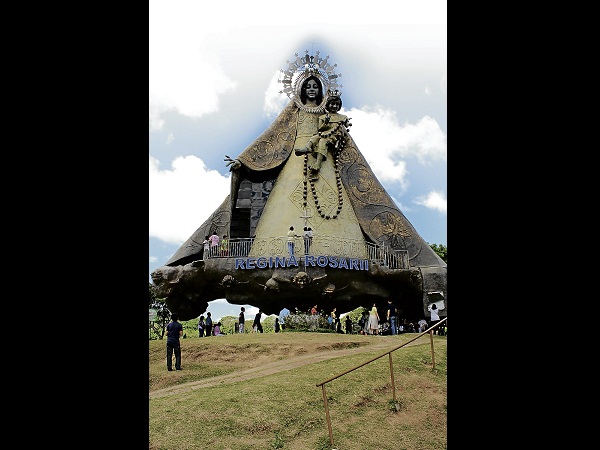
A 71-FOOT HIGH MADONNA AND CHILD image offers solace to the faithful and stands guard against follies that may hurt the environment. PHOTO BY PAOLO V. PAPA/CONTRIBUTOR
On the foothills of the longest mountain range in the Philippines, the Sierra Madre, is nestled a 13.5-hectare ecological sanctuary for spiritual worship and nurturing as envisioned by the Dominican sisters of the Regina Rosarii (Queen of the Rosary in Latin)—the Regina Rosarii Institute for Contemplation in Asia, or Regina Rica.
It is impossible to miss the site. The sanctuary is located on  Sitio Aguho Street in Barangay Sampaloc, Tanay, Rizal province, right after Camp Capinpin and the sprawling estate of former President Joseph Estrada.
A 71-foot high statue of Mary, Queen of the Rosary, carrying the infant Christ, beckons to one and all, guarding some 10,000 mahogany trees and several other kinds of trees and plant varieties, organic gardens and a collection of birds, monkeys, ducks, chicken, geese, hamsters, rabbits, carabaos and horses.
Visitors who stream in daily gladly abide by the reverent discipline of the dress code and subdued conversation as they immerse themselves in prayer under the protective mantle of Mary’s statue, or as they go through the labyrinths of the forest and as they partake of vegetarian food from the organic gardens. They also follow to the letter instructions for waste segregation, using the labeled bins for biodegradeable and nonbiodegradeable wastes.
Several signs announce that the area is a free-plastic zone. The sisters and staff are a wonderful example of volunteers or environmental warriors guarding this environmental haven. What highlights one’s visit is respect for the sanctuary, a deeper realization of one’s self and being and an appreciation of God’s grandeur, in the vision of the English poet and Jesuit priest Gerard Manley Hopkins.
No plastics, please
There is no entrance fee to Regina Rica.  Picnic areas are available for those who choose to bring their own food, but no plastics please. For those who prefer to leave their picnic hampers behind, a canteen  offers vegetarian food.
The sanctuary is open from  8 a.m. to 5 p.m. daily except Tuesdays, with a recitation of the rosary  from 4 p.m. to 6 p.m. There is a Mass every Sunday at 11 a.m., and every fourth Saturday of  the month at 6 a.m. For early risers, there is a dawn rosary at 5 a.m. every fourth Saturday of the month.
There is certainly a need for prayers, not only for human but for divine intervention.
Near the site, the once lush forests and plant and wildlife wealth of the city of Antipolo and the towns of  Montalban, San Mateo and Teresa are almost gone, as many of the hills have turned not only brown from denudation but have become like Lego blocks, gradually being chipped off till they are totally quarried to the ground turned parking spaces for passenger jeeps or commercial compounds. Worse, they have become deep and wide holes turned into dump sites.
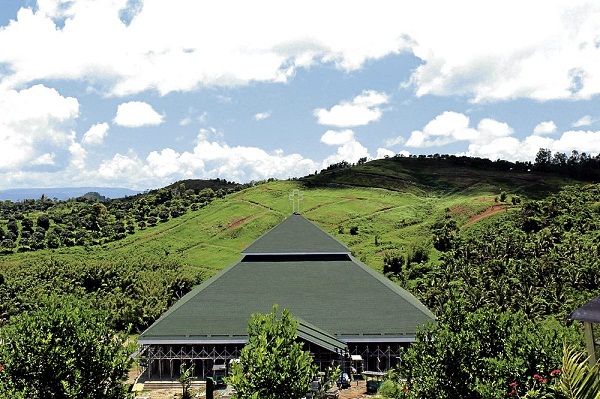
THE CHAPEL, currently under construction, is nestled amid some 10,000 mahogany trees. PHOTO BY PAOLO V. PAPA/CONTRIBUTOR
Rivers, once clear and clean and teeming with fish, have also become toxic with leachate from the garbage dumps and effluents from establishments and homes. Other rivers have been covered by a chaotic sprouting of miscellaneous structures for purposes not really different from high-end development projects with so-called “mixed use” setups.
Not too far away, more commercial interests are fast hacking away at pockets of trees that somehow still help add to the already much depleted supply of oxygen in the metropolis.
Concerned residents of neighboring Quezon City, for example, fear that the establishment of the so-called “central business district” will soon clear the remaining natural shelters of trees in the Parks and Wildlife reserve, the Manila Seedling Bank, the nursery of the Department of Environment and Natural Resources, the trees surrounding Children’s Medical Center and the Lung Center of the Philippines.
Using the Sierra Madre as her podium, Mary must be reminding those who profess to govern this land of their duty as leaders of what is touted as the center of Christianity in Asia: To abide by the faith they profess, carry out the duties and responsibilities they have sworn to do, and uphold the provisions of the 1987 Constitution of this land so blessed, as found in Section 16 under State Policies: “The State shall protect and advance the right of the people to a balanced and healthful ecology in accord with the rhythm and harmony of nature.”
Beyond Holy Week reflections
National and local leaders are advised to go to Regina Rica as part of their reflection even long after the Holy Week is over. We ask them, at least, to help prevent any more of the already threatening intrusions to the site, such as the presence of commercial hog farms and the sale of land rights, including mountain areas that are “titled”  and sold to influential and moneyed individuals and groups, to be used as private resorts or rest houses.
Aren’t these supposed to be protected areas? How did this come about?  There are reports that an influential person will soon put up a local Hollywood in the area. Meanwhile, Daranak Falls is now far from the enchanting hideaway it used to be years back.
Environment Secretary Ramon Paje, in a recent conversation, said the national and local governments should prevent the sale of government lands because as private properties, they  would be easily open for commercial use. “Let the trees in the parks and forests stay. There should be no-build zones in these areas,” he added.
It’s about time government passed the long-pending national land use law. And hopefully, the hills of Tanay—and Regina Rica will continue to live on not only in legend, photographs and in stories of lovers of nature and the environment.

Sunday, February 20, 2011

Small town cares for forests, farmers


By Jeffrey M. Tupas
Inquirer Mindanao

WAO, LANAO DEL NORTE, Philippines—For Perpetua Magdadaro, her name is her fate.
The 56-year old widow and mother of five, two of them farmers themselves, is living a life of endless romance with the sun that chars her skin as she toils the land.

Every morning, Magdadaro—which literally means “toiler”—wakes up even before the sky whitens in her upland village of Banga in Wao, Lanao del Sur.

“I have been a farmer all my life. And I will be a farmer forever,” says Magdadaro, whose father was also a farmer.
This is why she gives utmost importance to the protection of the environment, especially participating actively in the campaign to keep the remaining forest cover of Wao free from destructive human activities.
“I have realized that as farmers, the number one resource is the forest—the land, the trees, the water sources. And so there is a need to keep them protected,” she says.

Magdadaro had closely seen how Wao’s natural wonders turned into an ugly landscape. For 15 years, her husband worked for Timber Philippines Industries Inc. (Tipi), holder of a logging concession in Wao.

Mistakes of the past

“It pains me to look back but we have to do something to rectify the mistakes of the past. And now, I am one among those who stand to keep the remaining forests protected … and instead of cutting trees, the time calls for us to plant trees,” she said.

Magdadaro is the chair of the Banga Farmers and Watershed Development Cooperative, an active partner of the local government in protecting the forest.

Along with 45 other members of the cooperative, Magdadaro has pledged herself to become part of the movement which will ensure that Wao’s mistakes will never be repeated again.

“We do not need disasters to realize that disturbing the natural order of the environment and destroying life forms in the forest is deadly. All we need to do is to look ahead and ask ourselves: How about our children?” she says.


LGU action

Mayor Elvino Balicao says the local government has sought the help of farmers like Magdadaro in its bid to prevent further forest destruction.

Wao’s vigilance today is a result of an unfortunate event in history—at the expense of the forests—where residents took themselves to the streets to stop the operations of Tipi.

An emotional Edna Espinosa, one of the leaders of people’s organization Lihok Wao, says: “The bastardization of the forest during that time was just too much. They were cutting even the young trees ... we just had to do something.”

“The only thing that did not flow out of my eyes are blood. Still, I was ready to die fighting against logging at that time,” she says.

Espinosa’s group is still active in apprehending trucks moving logs through Wao from neighboring towns in the province of Lanao del Sur. That the local government is backing these moves has earned him death threats, Balicao says.
“But we have to do something to protect the remaining natural resources of the province. These trucks pass by here and so we have to hold them, no matter what,” he says.

“As for Wao, the water sources have gradually been depleted and this is absolutely the result of the logging operations here before,” Balicao says.


People’s efforts

He says the best weapon to keep the biodiversity of the forests of Wao is the very people who are living close to these areas—those who rely solely on farming for livelihood.

“They can still farm and conduct their activities but they have to make sure that they will be active in keeping the forests safe. They have to plant trees and ensure that their farming practices do not run counter to our objective of promoting sustainable development,” Balicao says.

Wao, a third-class municipality (annual income: P35 million-P45 million) with an estimated 42,000 population, was one of the early recipients of a technical assistance on the formulation of a forest land use plan from the US Agency for International Development-Philippine Environmental Governance (EcoGov) Project.

The project gave birth to Wao’s 10-year integrated solid waste management plan which later led to the construction of a P3-million sanitary landfill.

Now, the proper management of its watershed is the top priority of the local officials.


Forest co-management

Just last Jan. 28, the municipality passed an ordinance governing the “development, management and utilization of the co-managed forests and forest lands of Wao.”

(On April 11, 2006, Wao and the Department of Environment and Natural Resources entered into a co-management agreement over the allocation, management and development of the forest and forest lands of Wao covering 2,184 hectares of land.)

Through the ordinance, Magdadaro became a holder of an Individual Property Rights (IPR) instrument, which allows her to plant vegetables, fruits and high-value crops in forest clearings. The IPR—a management sub-agreement instrument under the local government’s Watershed Co-Management Program—ensures that “no person may utilize, exploit, occupy or conduct any activity within the co-management area or establish, install, add and operate a structure, unless he has been authorized to do so by the government.”


Livelihood support

The 25-year instrument provides Magdadaro and the other holders a reliable source of livelihood. The local government provides all kinds of support to those who are given free planting materials for crops, such as rubber, coffee, corn, fruits and vegetables.

Each holder can plant on at least 3 hectares of land. The holder will start to pay back the government when it becomes productive.

“We thought this co-management scheme was a threat to the farmers. We were scared of it, thinking that it was a tool of the government to dislocate the farmers. And we were wrong,” Magdadaro says.

For Balicao, introducing the IPR was a painstaking task for the local government unit, something that they had to pursue as its success would be beneficial for local-fund source and the protection of the environment.
Yearly, according to their estimate, the local government will be able to earn at least P135,000 from a hectare of land planted to rubber; P96,000 for coffee, and P42,000 for corn.

The local government has already issued 180 IPRs in the watershed villages of Pilintangan, Banga and Park Area—with 200 hectares already fully planted with crops and trees.


Galing Pook Award

Backing these efforts are the local industries. Wao’s watershed and forest management program recently won them the Galing Pook Award, a recognition given to local government units that are successful in implementing programs that show excellence in governance.


When in Cebu City, please visit gregmelep.com for your real estate and retirement needs.

Source: Philippine Daily Inquirer