China overtaking US as global trader
By Joe McDonald, Youkyung Lee
Associated Press
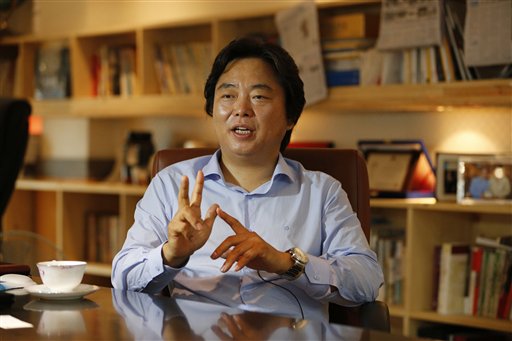
In this July 18, 2012 photo, Shin Cheol-soo, chief executive of ENA Industry, speaks at his office in Gyeongsan, south of Seoul, South Korea. Shin no longer sees his future in the United States. The South Korean auto parts supplier uprooted his family from Detroit this year and moved home to focus on selling to the new economic superpower: China. “The United States is a tiger with no power,” Shin said in his office, where three walls are lined with books, many about China. “Nobody can deny that China is the one now rising.” (AP Photo/Lee Jin-man)
SEOUL, South Korea—Shin Cheol-soo no longer sees his future in the United States.
The South Korean businessman supplied components to American automakers for a decade. But this year, he uprooted his family from Detroit and moved home to focus on selling to the new economic superpower: China.
In just five years, China has surpassed the United States as a trading partner for much of the world, including U.S. allies such as South Korea and Australia, according to an Associated Press analysis of trade data. As recently as 2006, the US was the larger trading partner for 127 countries, versus just 70 for China. By last year the two had clearly traded places: 124 countries for China, 76 for the US.
In the most abrupt global shift of its kind since World War II, the trend is changing the way people live and do business from Africa to Arizona, as farmers plant more soybeans to sell to China and students sign up to learn Mandarin.
The findings show how fast China has ascended to challenge America’s century-old status as the globe’s dominant trader, a change that is gradually translating into political influence. They highlight how pervasive China’s impact has been, spreading from neighboring Asia to Africa and now emerging in Latin America, the traditional US backyard.
Despite China’s now-slowing economy, its share of world output and trade is expected to keep rising, with growth forecast at up to 8 percent a year over the next decade, far above US and European levels. This growth could strengthen the hand of a new generation of just-named Chinese leaders, even as it fuels strain with other nations.
Last year, Shin’s Ena Industry Co. made half his sales of rubber and plastic parts to US factories. But his plans call for China, which overtook the United States as the biggest auto market in 2009, to rise fivefold to 30 percent of his total by 2015. He and his children are studying Mandarin.
“The United States is a tiger with no power,” Shin said in his office, where three walls are lined with books, many about China. “Nobody can deny that China is the one now rising.”
Trade like football
Trade is a bit like football—the balance of exports and imports, like the game score, is a neat snapshot of a jumble of moves that make up the economy, and both sides are apt to accuse each other of cheating from time to time. Also, the US and China are both rivals and partners who can’t have a match without each other, and a strong performance from both is good for the entire league.
Trade may get less publicity than military affairs or diplomacy, yet it is commerce that generates jobs and raises living standards. Trade can also translate into political power. As shopkeepers say, the customer is always right: Governments listen to countries that buy their goods, and the threat to stop buying is one of the most potent diplomatic weapons.
China has been slow to flex its political muscle on a large scale but is starting to push back in disputes over trade, exchange rates and climate change.
“When a German chancellor or French president goes to China, right at the top of the list, he’s trying to sell Airbuses and other products and is being sensitive to China’s political concerns, like on human rights,” said C. Fred Bergsten, a former US Treasury Department official who heads the Peterson Institute for International Economics in Washington.
The United States is still the world’s biggest importer, but China is gaining. It was a bigger market than the United States for 77 countries in 2011, up from 20 in 2000, according to the AP analysis.
The AP is using International Monetary Fund data to measure the importance of trade with China for some 180 countries and track how it changes over time. The analysis divides a nation’s trade with China by its gross domestic product.
The story that emerges is of China’s breakneck rise, rather than of a US decline. In 2002, trade with China was 3 percent of a country’s GDP on average, compared with 8.7 percent with the US. But China caught up, and surged ahead in 2008. Last year, trade with China averaged 12.4 percent of GDP for other countries, higher than that with America at any time in the last 30 years.
Of course, not all trade is equal. China’s trade is mostly low-end goods and commodities, while the US competes at the upper end of the market.
Also, even though Chinese companies invest abroad and employ thousands of foreign workers, they lag behind American industry in building global alliances and in innovation, which is still rewarded in the marketplace. China’s competitive edge remains low labor and other costs, while the US is the world’s center for innovation in autos, aerospace, computers, medicine, munitions, finance and pharmaceuticals. The Chinese have yet to build a car that will pass US or European emission standards.
And the United States still does more trade overall—but just barely. If the trend continues, China will push past the U.S. this year, a remarkable feat for a country so poor 30 years ago that the average person had never talked on a telephone.

In this Oct. 10, 2012, photo, vehicles make their way along a new 50-kilometer (30-mile) highway leading north of the capital of Nairobi in Kenya. The $300 million road was built by three Chinese companies and financed by the African Development Bank and the Chinese Exim Bank. AP PHOTO/BEN CURTIS
“The center of gravity of the world economy has moved to the east,” said Mauricio Cardenas, the finance minister in Colombia. Like most of Latin America, his country is still more closely tied to the US, but its trade with China has risen from virtually nothing to 2.5 percent of GDP, a more than tenfold increase since 2001. “I would say that there is nothing comparable in the last 50 years.”
In one sense, China’s growing presence in trade is just restoring the Middle Kingdom to its historic dominance. China was the biggest economy for centuries until about 1800, when the industrial revolution propelled first Europe and then the US into the lead.
China began its return to the global stage in the 1990s as a manufacturer of low-priced goods, from T-shirts to toys. Factories in other countries slashed costs to meet the “China price” or were pushed out of the market.
As the new millennium dawned, the US remained by far the world’s dominant trader, rivaled collectively by Europe but no single nation. However, from 2000 to 2008, China’s imports grew 403 percent and exports 474 percent, driven in part by its entrance into the World Trade Organization and its move to higher-value production.
China’s imports of oil and raw materials for its factories propelled resource booms in parts of Asia, Africa and Latin America. China’s demand for steel for manufacturing and construction grew so fast that its mills now consume half the world’s output of iron ore.
Zambia, a major copper producer, switched to the China column in 2000. Australia, a coal and iron ore exporter, followed in 2005. Chile, another copper supplier, moved in 2009.
Meanwhile, exports surged as Apple, Samsung, Nokia and other electronics giants shifted final assembly to China. Shipments of mobile phones, flat-screen TVs and personal computers have jumped sevenfold over the past decade to nearly $500 billion. That made China a major customer for high-tech components supplied by countries such as South Korea, which swung into China’s column in 2003, followed by Malaysia in 2007.
In the US, Vermont-based manufacturer SBE Inc. started exporting capacitors—energy-storage devices used in computers, hybrid cars and wind turbines — in 2006. The company now gets 15 to 20 percent of its revenue from China, and has hired 10 employees there.
As China grew richer, its people spent more.
Chinese ate more pork, fried chicken and hamburgers, rapidly sending up the demand for soybeans to make cooking oil and feed for pigs and cows. Some cattle ranchers in Latin America turned grazing land into fields of soy, a crop few in their region consume. Soybean exports helped push Brazil into the China column in 2010, and put China neck and neck with the US as Argentina’s top trading partner.
In the Brazilian state of Mato Grosso, some 10,000 miles (17,000 kilometers) from Beijing, farmer Agenor Vicente Pelissa and his family raise cattle and soy on 54,300 acres, a farm twice the size of Manhattan. Half their 21,000-ton annual soybean harvest goes to China.
“We’ve invested more in technology and in better machines and equipment to meet this rising demand,” Pelissa said. “If it hadn’t been for China, we would have not modernized our operations, at least not as quickly as we did.”
Even in the US, better known for manufacturing, farmers are rushing to sell to China. The United States is the largest exporter of soybeans to China, followed by Brazil and Argentina. China’s purchases of American soybeans have risen from almost nothing 20 years ago to a quarter of the crop: 24 million tons worth $12.1 billion, America’s largest export to China.
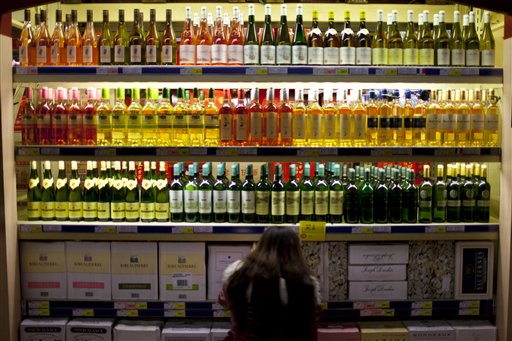
In this Nov. 27, 2012, photo, a customer checks bottles of imported wine at a supermarket in Beijing, China. Rising incomes have driven demand for wine and other luxury goods, making China a lifeline for European and American vineyards when the global crisis battered traditional markets. AP PHOTO/ALEXANDER F. YUAN
The boom is having a profound effect on farming communities, said Grant Kimberley, whose family farm near Des Moines, Iowa, now grows 4,000 acres of soybeans, up from 3,500 eight years ago.
“It’s provided more revenue for these farmers than they’ve ever seen in their lives,” said Kimberley, who is also director of market development at the Iowa Soybean Association. He said he sees more young people returning to the farm. “People can see there’s an opportunity to make nice livings for their families.”
2008 global crisis
It was the 2008 global crisis that showed the resilience of China’s exporters.
The recession set everyone back, but China less so than the US or other major traders such as Germany. China does a bigger share of its trade with developing countries that suffered less and rebounded faster, while the United States sells to rich economies that are struggling. Chinese companies have boosted exports by 7 percent this year despite anemic global demand.
During the recession, Shin, the South Korean auto parts manufacturer, saw his sales fall 50 percent. He shut one of three production lines, and banks stopped lending him money.
But China’s auto market was powering ahead. So Shin hired an employee in China, and is now making plans for his first factory there. On a business trip to Germany, clients told him their Chinese factories would be larger than those at home.
Parents like Shin, who work at companies doing business with China, in turn fed enrollment growth at schools such as Teacher Ching, a Chinese-language kindergarten in Seoul.
Nancy Ching, the daughter of immigrants from Taiwan, opened the school with 15 students in 2004, the year after South Korea first moved from the US column to the China column. Today she has 60.
“Mothers who send their kids here believe our children’s generation is the China generation,” she said in Chinese-accented Korean. “In the future, without learning Chinese, one won’t be able to get a job.”
China resumed its upward trajectory in the last two years. Even with key Western markets in a slump, exports are up 58 percent since 2009. Imports are up an even sharper 73 percent.
Rising incomes have driven demand for wine and other luxury goods, making China a lifeline for European and American vineyards when the global crisis battered traditional markets.
The Chinese have “helped Bordeaux a lot these past three years,” said Florence Cathiard, owner of Chateau Smith Haut Lafitte in the Pessac-Leognan area of France’s southwest, home of high-end Bordeaux wine.
France’s wine exports to China first surged in 2009, and by last year, China had surpassed the US as a customer by volume. Americans still spend more, because they buy more expensive wines. But China is developing a taste for grand cru wine, the “great growths” that are considered exceptional and command higher prices.
Cathiard acknowledged that she was initially wary of China as a reliable market for her high-end wines. But the turning point for her came around 2008, when she was blown away by the number of people showing up for a master class by her chateau at a wine expo in Hong Kong.
China now accounts for 25 percent of Cathiard’s sales, making it her largest market.
The owners of Chateau Haut-Bailly, also in Pessac-Leognan, first traveled to China to test the waters in 2000, and it was too early.
“At the time, they didn’t know what a cork or a corkscrew was,” said Veronique Sanders, the chateau’s general manager.
Chinese sophistication has since advanced rapidly, she said.
“The difference with other emerging markets we’ve gone into in the past is the size of the country, which means it has an absolutely incredible potential.”
Overseas investments
The next step in China’s trade evolution is to move beyond exporting TVs and lawn furniture to selling services and investing abroad.
The investment trend started with state-owned companies that bought stakes in foreign mines and oil fields. Smaller and private Chinese companies followed, acquiring foreign enterprises to gain a bigger foothold in overseas markets, more access to resources and better technology for their own development.
China is now pushing into construction and engineering, where US and European companies have long dominated.
In Algeria, Chinese state-owned companies pushed aside established French and German rivals to win contracts to build a $12 billion cross-country highway and the $1.3 billion Great Mosque of Algeria. The Chinese have also built highways, dams and other projects in developing countries and are starting to win contracts in the U.S. and Europe.
On a new 50-kilometer (30-mile) highway leading north of Nairobi, the capital of Kenya, dark asphalt stretches across six to eight lanes.
The $300 million road was built by three Chinese companies and financed by the African Development Bank and the Export-Import Bank of China. It has cut a trip that took several hours 18 months ago to 10 minutes, said Joseph Makori, a professional driver.
“When we see the people from America, they say, ‘We want to assist Kenya,’” said Makori as he looked for work at an interchange about 10 kilometers from downtown. “But I don’t see it. China comes and I see one thing: the road.”
Chinese companies are starting to win government contracts in Kenya, which has ports that offer access to landlocked Uganda, South Sudan and Rwanda. Governments in Africa are keen to work with China because it does not tie development to human rights or democracy, said Stephen Mutoro, secretary general of the Consumer Federation of Kenya.
“China appears to have a long-term plan based on increasing its commercial interests where governance issues are given a back burner,” Mutoro said. The experience of Congo might foreshadow a more complex approach that Beijing envisages for other African nations. In 2008, the two governments signed a $9 billion deal for Chinese companies to build 177 hospitals and health centers, two hydroelectric dams and thousands of miles of railways and roads. In exchange, Congo was to provide 10.6 million tons of copper and 600,000 tons of cobalt.
The deal has since been scaled back to $6 billion under pressure from the International Monetary Fund, which felt Congo was taking on too much debt.
China’s outbound investment totaled $67.6 billion last year—just one-sixth of America’s nearly $400 billion—but it could reach $2 trillion by 2020, according to a forecast by Rhodium Group, a research firm in New York City.
As a result, Chinese companies are using a new export—jobs.
Employees at Volvo Cars worried after Chinese automaker Geely Holdings bought the money-losing Swedish brand from Ford Motor Co. in 2010. But two years later, instead of moving jobs to China, Geely has expanded Volvo’s European workforce of 19,500 to about 21,500.
Majority-owned US affiliates of Chinese companies support about 27,000 American jobs, up from fewer than 10,000 five years ago, according to Rhodium.
In Goodyear, Arizona, Stacey Rassas was laid off in May 2010 after a 16-year career in quality control for aerospace and aluminum manufacturers. By late autumn, she and her husband were worried they might lose their house.
She finally landed a job that December at a new factory that makes solar panels for one of the world’s biggest solar manufacturers.
“It was the best day ever,” she said.
Her new employer? Suntech Power Holdings Co., a Chinese company.—With
Sarah DiLorenzo, Jonathan Fahey, Scott Mayerowitz, Michelle Faul, Louise Nordstrom, Luis Andres Henao, Cesar Garcia, Paul Schemm, Stan Lehman, Troy Thibodeaux, Jason Straziuso, Tom Odula and Pailin Wedel
When in Cebu City, please visit http://www.gregmelep.com for your real estate and retirement needs.
Avail of the opportunity to own a condominium unit in Cebu City together with your own parking space at the low amount of only P12,000.00+ and House and Lot @ P 7,306.81/month only. Hurry while supply of units still last. Just call the Tel. Nos. shown herein: (053)555-84-64/09164422611/09173373687.

