Showing posts with label adobo sa gata. Show all posts

Thursday, January 19, 2012

Adobo sa Gata


By: 


 0share68 48

ADOBO sa Gata
I was pleasantly surprised when I walked into Dusit Hotel’s Basix Restaurant recently.  The lunch buffet not only offers more choices now, there are also cooking stations that serve dishes to order. One station cooks pasta with your choice of sauces, another station serves either roast pork or roast US prime rib of beef, and there’s a large assortment of fresh seafood that can be grilled to order.
Aside from the familiar Chinese dim sum and Japanese dishes (sushi, maki, tempura), there’s a corner dedicated to Indian cuisine. Chicken, lamb, prawn and fish tandoori are served together with assorted condiments and Indian bread such as pappadum and naan.
Meanwhile, a corner full of mezze (Middle Eastern appetizers) reminded me of a visit to Dubai many years ago. Hummus, tabouleh and stuffed vine leaves also share table space with large black and green olives, pita bread, baba ganoush and cucumber-yogurt dip.
Diners who love salmon will really like the gravlax, served with dill and pepper, as well as the thin slices of lapu-lapu topped with salmon carpaccio.
Amid the global fare, there are Filipino dishes, too. One in particular caught my attention: duck cooked in coconut milk, adobo style. If there’s one dish beloved by Filipinos, it’s adobo, in all its variations and mutations. Basix’s version uses duck, rather than chicken or pork, and is cooked with thick coconut cream. Sous chef Joel Cruz was generous enough to share the recipe with me, which I found very simple and easy to cook (I adjusted the recipe to suit the home cook).
(Lunch buffet in Basix is P1,600 net, while dinner is P1,800 net. Call 2388888, ext. 8430.)
Adobo sa Gata
(Makes around six servings. If you can’t find duck, chicken is a good substitute.)
1 medium onion, chopped
3 cloves garlic, minced
½ c vinegar
½ c soy sauce
1 whole duck or chicken, cut into serving pieces
3 tbsp cooking oil
Salt, to taste
1 ½ c coconut cream (kakang gata, may use canned)
1 red bell pepper, cut into strips (optional)
1 green chili pepper, cut into diagonal slivers (optional)
Combine onion, garlic, vinegar and soy sauce in a bowl.  Pour over the duck or chicken pieces and let chicken marinate for one hour.
When ready to cook, heat oil in a large casserole. Remove duck or chicken from marinade  (reserve themarinade) and cook in the hot oil just until brown, turning once. Spoon off excess oil from the pan, if any.
Pour in the reserved marinade and season with salt. Simmer until almost tender, around 20 minutes.  Add the coconut cream and bay leaves and simmer for another 15 minutes or until duck or chicken is fully cookedand tender.
If desired, add the bell pepper strips and chili pepper during last five minutes of cooking. Serve hot with steamed rice.
Cook’s tips:
*If using the canned variety, make sure you use coconut cream, which is thick, and not coconut milk, which is thin and watery (check labels). Stir the coconut cream well before using.
*If using fresh gata, use the first pressing of squeezed coconut meat.
*When browning the chicken, do it in batches so as not crowd the pan.

And when Cebu City, please visit gregmelep.com for your real estate and retirement needs.

Wednesday, January 18, 2012

With wild mushroom, gizzards, oregano–it’s ‘adobong’ Caviteño!


By: 


 4share90 57

BERT Torrijos, a true-blue Caviteño PHOTO BY ANDREW TADALAN
Adobo is one of those dishes that can be either really spectacular or mediocre. But, this hand-me-down recipe becomes extra special due to a few interesting twists and tricks.
The use of wild mushrooms and gizzards (not liver), enhances the classic salty-sour adobo flavor. The addition of oregano further fortifies the taste.
“It’s simple, fast and packed with flavor,” says Bert Torrijos, a true-blue Caviteño. “It’s quite easy to make, yet may be one of the best-tasting adobos to ever cross your lips.”
Indeed, this adobo’s great flavor comes from marinating the meat overnight to allow the flavor to seep into the flesh liberally. The woodsy mushroom produces a savory texture. There’s no need to use liver for depth, just gizzards (balunbalunan) browned to perfection, and lots and lots of garlic.
“I prefer wild mushroom than button mushrooms, which are pretty tough,” says Torrijos. “Wild mushrooms are soft, especially when mixed with vinegar and soy sauce. It melts in your mouth.”
Even if you’re not a gizzard fan, good adobo with gizzard can win over anyone with an aversion to it, says Torrijos. The inclusion of hard-boiled chicken eggs and quail eggs offers a richer, tastier bite. While most of the ingredients in this recipe just go together naturally, another key to good adobo is cooking it slowly until the natural flavors blend harmoniously..
“This adobo has it all—sweet, sour, salty, spicy with tons of texture from chicken, gizzards, mushrooms an eggs,” says 67-year-old Torrijos. “For me, its simplicity in preparation and presentation is part of its delicious appeal. It’s only the ingredients that truly make the difference.”
Heirloom recipe
Torrijos has been cooking this adobo for decades now after he learned it from his late father, who was a Caviteño. His mother, now 94 years old, also hails from General Trias, Cavite.
“I grew up in Cavite and this is the kind of adobo I learned to eat and enjoy while growing up,” he says.
At home in Melbourne, Australia (Torrijos is an Australian citizen), he cooks adobo for his two children and six grandchildren.
“I cook Pinoy food like kare-kare and pork sinigang but it’s my chicken adobo that my grandchildren, Bianca and Bettina, love so much. They love the saucy flavor and the eggs.”
Hospitality
Torrijos is the president and general manager of Jade Vine Restaurant and Executive Inn on Jorge Bocobo corner United Nations Avenue, Manila. He travels every six months to Australia to check on his family and his food consultancy firm.
He joined Jade Vine in 1962 as a busboy when he was only 16 years old. He was a working student throughout college at Lyceum of the Philippines, where he finished Economics. He also studied public relations at the Ateneo de Manila University and special courses on hotel management at Cornell University.
“On my days off, I would try my hand in the kitchen and cook whatever dishes I could think of,” Torrijos recalls.
He rose from the ranks. From bus boy, he was promoted to waiter. When he left Jade Vine, he was already a catering supervisor. He left the restaurant when his wife passed away in 1977.
He later worked for his brother-in-law in a rubber factory in Cavite. However, his real calling and passion was in the hospitality industry, so he decided to go back and worked at the Westin Philippine Plaza (now Sofitel Philippine Plaza) as the first manager of the coffee shop. He also joined other hotels and restaurants, including the Hyatt Terraces Hotel in Baguio City as food and beverage manager.
A job opportunity to work in Australia as a consultant for a restaurant in Geelong, west of Melbourne, came in the 1980s. He eventually became a citizen.
“I’ve lived in Australia for 30 years, but I always miss the Philippines,” Torrijos admits.
Now, he runs the Jade Vine again and goes back and forth to his other home in Australia.

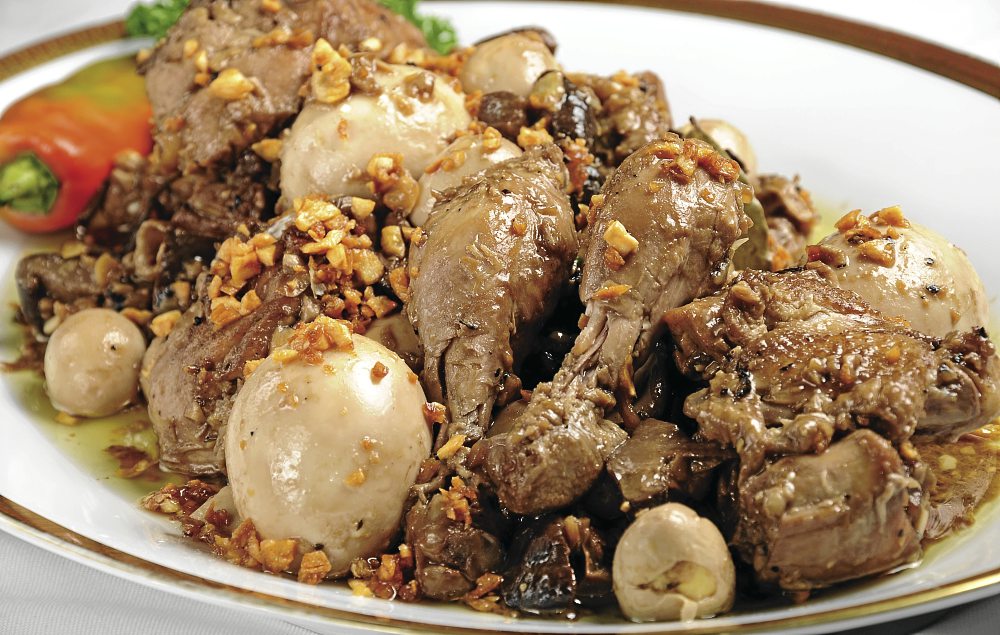
CHICKEN adobo with eggs and toasted garlic. PHOTO BY ANDREW TADALAN
1 k chicken, adobo-cut
¼ c chicken gizzards
Hard-boiled quail eggs
Hard-boiled chicken eggs
Baby wild mushrooms
½ c vinegar
½ c soy sauce
1 head garlic, crushed
2 bay leaf
1 tbsp whole peppercorns
1 tsp oregano
1 tsp brown sugar, just to enhance the flavor
Toasted garlic for topping
In a bowl, marinate the chicken, gizzard and mushrooms with soy sauce, vinegar, garlic, bay leaf, peppercorns and oregano overnight. Then, remove chicken and gizzard from the marinade and fry the meat in a hot pan with oil.
After frying, return the meat into the marinade and cook in low-fire till it boils. Then, simmer for a few more minutes.
Add eggs and sugar. Simmer again. Before serving, sprinkle toasted garlic on top of the adobo.
Yield: Six servings.