Showing posts with label tree planting. Show all posts

Friday, June 17, 2011

Philippine forest project gets carbon credits


By 
INQUIRER.net


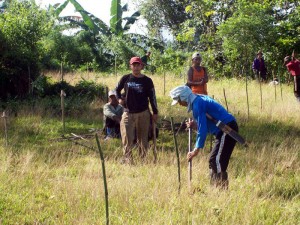
Planting activity at one of the reforestation sites in Quirino. Photo by Conservation International-Philippines
MANILA, Philippines—A breakthrough for the environment sector of the Philippines has recently come in the form of a local reforestation and agroforestry project that gained international recognition for providing “real, additional and permanent greenhouse gas emissions.”
The Quirino Forest Carbon Project (QFCP) of the Conservation International-Philippines has been acknowledged under the Verified Carbon Standards (VCS) program, a global standard and quality assurance system at the forefront of accounting greenhouse (GHG) emissions reductions in the voluntary carbon market.
The project was accepted in the VCS program after its standards were approved in June by a third party auditor, the Rainforest Alliance. Last year, it was also awarded a Gold-level under the Climate, Community and Biodiversity (CCB) Standards for including community and biodiversity benefits in implementing the project.
Implemented in a 175,943-hectare protected area in the province of Quirino called the Quirino Protected Landscape (QPL), the project sits amid a rich biodiversity—endemic and threatened flora and fauna. It supports the sustainable development of nearby provinces. The project envisions to produce long-term lessening of greenhouse gas emissions by restoring and protecting the QPL.
QFCP is the first forest carbon project in Asia to receive both VCS and CCB accreditations.
Romeo Trono, country executive director of Conservation International-Philippines, said that this was the first time that a project in the Philippines or in Asia has achieved a claim on carbon credits under VCS.
He said that with this development, agencies and companies in the country will be able to acquire carbon credits from local reforestation projects.
Trono said most carbon credits in the country came from the renewable energy sector.
Calling the project a “breakthrough for GHG removal,” Conservation International said that the forestry sector will not be the lone beneficiary of the project but local communities as well.
“It is a three-pronged approach to helping the country by providing communities with alternative livelihood from the reforestation and agroforestry efforts, while simultaneously contributing to mitigating climate change and protecting threatened biodiversity,” Trono said.
He explained that coordination is being done with local communities in implementing the project, “letting them enjoy livelihood benefits while also providing practical, affordable solutions to climate change concerns.”
Aside from proposing an alternative income and promoting the protection of plant and animal habitats, Trono said the project also helps ensure that a steady supply of water is available for the communities by maintaining the watershed.
Under the project, 177 hectares of agroforestry and reforestation parcels will be set up within Integrated Social Forestry (ISF) farms to be managed by volunteers from the local community. The volunteers are persons who agreed to have their land used in the project for the next 23 years.
The QFCP has planted fruit trees like lanzones, rambutan and citrus trees as well as indigenous trees like molave, kalantas, narra and balakat gubat in 41 hectares of land. Fruit trees will continuously be planted on 136 hectares of land in villages covered by the project this year.
The project expects to gather 31,771 in total carbon dioxide in the entire duration of the project while providing benefits to 96 households.
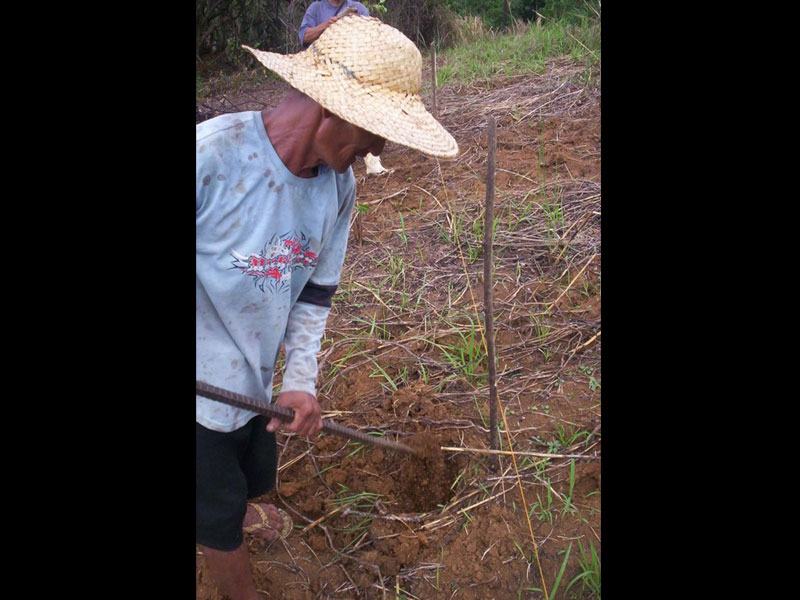
Preparing the hole for tree planting. Photo by Conservation International-Philippines
Conservation International has teamed up with Moretrees, a non-profit carbon offset provider. The project, according to Conservation International is a “very good example of invoking partnerships with the private sector in addressing simultaneously community development, biodiversity conservation and climate change mitigation/adaptation for sustainability.”

Saturday, March 12, 2011

Camsur sets tree-planting world record


Juan Escandor Jr. 
Inquirer Southern Luzon
PILI, Camarines Sur, Philippines—Breaking a world record, Camarines Sur province on Wednesday planted the largest number of trees simultaneously in one hour—64,096—demolishing the previous record of India at 50,033 trees, the adjudicator of the Guinness Book of World Records announced here.
Seyda Subasi Gemici said the validation of the tree planting event followed the requirements of the Guinness Book of World Records, including the assignment of a supervisor or observer for every 50 participants.
She said the previous record for the largest number of trees simultaneously planted in one hour was undertaken by 9,913 people in India, which accomplished the feat on Oct. 10, 2010. In Camarines Sur, more trees were planted by 6,892 individuals.
But Gemici, a Turkish national, said what was important was the number of trees planted because that was the record sought to be broken.
Governor Luis Raymund Villafuerte Jr. said they planted the record-breaking number in only 15 minutes, which Gemici confirmed.
“I heard a lot of people say a day before they’ve to stay there overnight to participate in the record attempt, which is amazing,” said Gemici.
She said she climbed the mountain site of the tree-planting in the municipality of Siruma immediately after arriving in Camarines Sur on Wednesday. She arrived in Manila Tuesday following a long trip from Australia to Istanbul and then to Dubai.
Gemici said she was very excited about the activity when they flew to Siruma and thanked the provincial government for the “perfect organization.”
Gemici said each of the supervisors had to give their statement regarding the number of participants and the number of trees planted within the 32-hectare area.
She said applying for a world record may be done on-line and her Guinness colleagues would evaluate the project and spell out the requirements.
The Guinness Book of World Records is published once a year, in September, with entries comprising only some 4,000 categories out of some 30,000 categories in their database. The record will stay until someone else breaks it for a new world record, said Gemici.
Villafuerte said that more important than setting a new world record, the feat was a demonstration by the people of Camarines Sur that they can work together to make something happen.
“When people unite, cooperate and help each other, there seems to be no impossible endeavor,” he said.
He said he decided to take up the challenge because the endeavor was more meaningful than other kinds of records.
“We don’t want a longest or biggest record of something. This is the first world record of Camarines Sur to show that we care for the environment because we want to (take the) lead in the initiative against climate change,” he said.
Mayor Sandy Ondis of Siruma said it took them three weeks to prepare for the record-setting event, which involved close coordination with the provincial government, village officials and religious and civil society groups in the area.
“But the most important message of our feat is that people were able to understand the problem of climate change in which we could do something to set back the ill effects by planting trees,” Ondis said.
Lucena Bermeo, operations officer of the activity, said the 32-hectare site was divided into quadrants with 50 participants in each quadrant and 500 tree seedlings.
“Each quadrant has one supervisor who tallied manually as against the bar codes. It took us one week to place bar codes on 70,000 tree seedlings,” she said.
Bermeo said the tree-planting activity for the Guinness Book of World Records was part of the “El Verde" tree planting program of the province of Camarines Sur that aims to plant 12 million trees from 2011 to 2012.
Source: Philippine Daily Inquirer