Showing posts with label tarsier. Show all posts

Sunday, July 8, 2012

Bohol Aims For The Top


Danao Adventure Park
The province of Bohol is out to reclaim its post as the top tourist destination in the country.
This is the newfound vision of the government of Bohol, which recently launched its newest tourism campaign—dubbed as Bohol: Heart of the Islands, Truly Philippines—in partnership with Philippine Bohol Arts Foundation Institute (PABFI) and the province’s tourism stakeholders.
Aimed at immensely boosting local and foreign tourist arrivals and making the province the country’s preferred travel destination, the campaign showcases Bohol’s rich cultural and historical heritage, highlighting its rich eco-cultural value beyond the Chocolate Hills and the diminutive tarsiers, the world’s smallest primate.
"Other than the usual sites that are being promoted here—the Loboc River, the Chocolate Hills, the tarsiers, and the white sand beaches of Panglao—there is more to discover in Bohol that will make greater tourism impact, not only for the province, but also in relation to the Philippine context of promoting the country," said Bohol Governor Edgar MigriƱo Chatto.
The event, held at the Centennial Hall in Manila Hotel, gathered key public officials and tourism leaders, including Manila Hotel President and former senator Joey Lina, Philippine Tour Operators Association (PHILTOA) President Cesar Cruz, and Tourism Secretary Ramon Jimenez, Jr.
Located in Central Visayas, Bohol literally sits at the heart of the Philippine archipelago. Boasting of diving sites revered as among the best worlwide, the province is home to a number of natural wonders, such as—aside from the Chocolate Hills—the biggest mangrove plantation in Asia, and the Dajanon Bank, the lone double-barrier reef in the region and one of only six such marine structures in the world.
“Bohol and its people have a certain respect and appreciation for heritage and tradition,” Chatto shared. “This is why we have come up with this campaign to highlight the captivating charm that Bohol exudes and the heartwarming hospitality offered by Boholanos themselves.”
One of the things that Bohol would like to promote and enrich through its new tourism campaign is the element of nationalistic pride. “By showing everyone how Boholanos have preserved practices and beliefs that other Filipinos have already seemed to forget, we are also able to emphasize the value of cherishing their heritage,” PBAFI Executive Ria Cauton noted. “In an age when our culture are soaked in various colonial ideas and influences, that’s really something that has become rare.”
Bohol’s colorful history can be seen all over the province—especially when one looks upon its well-preserved Hispanic structures scattered all over, like the Church of Our Lady of the Assumption in Dauis, which attracts thousands of devout Catholics every year, and the Church of Our Lady of the Immaculate Conception in Baclayon, which is touted as Asia’s best-preserved Jesuit church.
In addition, other reasons that permit the province to say, ‘You can’t say you’ve been to the Philippines and truly experienced Filipino culture without having gone to Bohol,’ are its rich and distinct culinary offerings, vibrant nightlife, thriving art scene and ancestral craft-making practices. All of these underscore the fact that, indeed, one of Bohol’s main assets are its hospitable, constantly jovial and honest people.
“You don’t have to be from Bohol to love Bohol,” revealed Secretary Jimenez. “It’s simply being part of a rich cultural experience that makes a visit to Bohol unforgettable. The Loboc Children’s Choir, for example, has become a symbolic icon of the province precisely because, as an American friend who heard them once said, ‘You cannot sing the way they do if you are not happy.
”

Tuesday, December 13, 2011

Tourism threatens tiny Philippine primate


 0shareNew 0
BOHOL, Philippines—The tiny creature turns its head slowly through 180 degrees and stares, boggle-eyed as another group of noisy tourists takes its picture from just inches away.

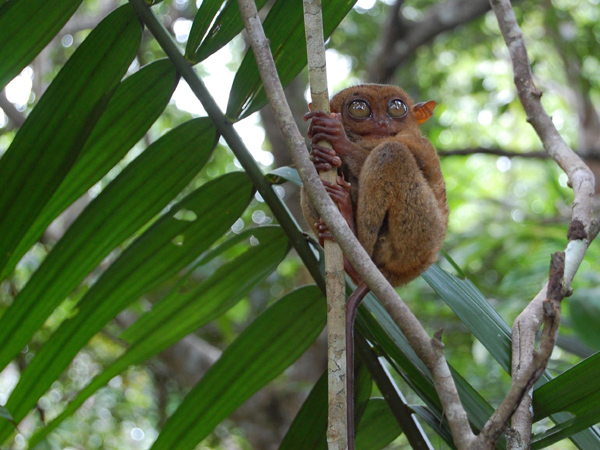
Philippine tarsier. JOE SINCLAIR/ AFP PHOTO
This is the Philippine tarsier, one of the smallest primates in the world. It is a remarkable animal, just 10 centimeters (four inches) tall, weighing 120 grams (four ounces), with a rat-like tail, bat-like ears, and giant eyeballs, each one as big as its brain.
Its strange appearance is obvious, but what these tourists may not realize is that their very presence is putting the animal at risk.
The tarsier is nocturnal, lives in the forest, and is highly sensitive to daylight, noise and human contact.
According to conservationists, if it becomes stressed it will kill itself by bashing its head against a tree or the bars of its cage.
“People go near and they’re loud, or make a picture with the flash, or they’re touching them. Most of those tarsiers, when they become stressed they commit suicide,” says Carlito Pizarras, known as The Tarsier Man.
“They don’t breathe and slowly die. If you put them in a cage they want to go out. That’s why they bump their heads on the cage, and it will crack because the cranium is so thin.”
Pizarras is the field manager at the Philippine Tarsier and Wildlife Sanctuary in Corella on the island of Bohol, one of the country’s most popular tourist destinations.
Unlike other tarsier attractions on the island, visitors at the sanctuary are allowed to look, but not to get too close, and definitely not to touch.
Different species of tarsier are found in the Philippines, Brunei, Indonesia and Malaysia. And populations in all these countries are listed by the International Union for Conservation of Nature (IUCN) as “decreasing”.
The Philippine tarsier, or tarsius syrichta, is categorised as “near threatened”, while species in other countries are already “vulnerable”, “endangered” and “critically endangered”.
As a child Pizarras would hunt tarsiers with his father, a taxidermist. The stuffed creatures were best sellers, fetching P250 ($6) a time.
Aged 12, he decided to start keeping the animals in captivity, venturing into the forests at night to collect crickets for them to eat and learn about their habits in the wild. He realized how sensitive they were to human contact.
By the time he reached his 20s the tarsiers living around his village were becoming scarce. Hunting, habitat destruction and predatory house cats were causing numbers to dwindle.
Pizarras knew he was also partly to blame, so he stopped hunting them and became a pioneer of conservation.
The tarsier became Bohol’s logo, and a big tourist draw. And the Tarsier Man, once derided for his strange behavior, became a national treasure, even presenting a pair of the animals to Britain’s Prince Charles in 1997.
But Pizarras, now in his 50s, believes not enough is being done to protect the creature. It may be a tourist symbol, but more should be done to make it a symbol of conservation.
“In other areas they are still putting tarsiers in cages for the tourists,” he says. “I don’t know why but the government gives them permits.”
At one of these attractions, a guide calls to a group of tourists and points to a tarsier clinging to a tree branch.
“Now there you are, I think you are hiding,” he says in a loud sing-song voice, before encouraging the group to move closer and take a picture.
A sign warns visitors not to use their camera flash, and the guide tells them not to touch.
But the tarsiers here live in a thinly forested area, with light seeping through. Their ultra-sensitive eyes are murky, and their movements slow. At this time of day they should be asleep.
“Before we put them in our hands,” the guide says. “But if you touch, they die. They are so very sensitive.”
These ones have been “domesticated” using cages, he adds, and now they are “tame”.
“Try to go closer,” the guide says. “They won’t bite.”
Pizarras argues that tarsiers in the wild are very defensive and do bite — and that these docile animals are not tame but weak.
“The tarsier is a superstar but unfortunately it’s suffering because of its fame,” says Joannie Mary Cabillo, the programme manager at the Tarsier and Wildlife Sanctuary.
“The government is backing up but not that much. We have a presidential proclamation and laws to protect the tarsiers but unfortunately nobody is sanctioned.”
The government declared the tarsier a “specially protected” species in 1997, outlawing hunting of the animal, and effectively banning restaurants and souvenir shops from keeping them on display.
Theresa Mundita Lim, director of the Protected Areas and Wildlife Bureau at the Department of Environment and Natural Resources (DENR), says the indications are that the tarsier population has gone up since then.
But she acknowledges that tarsier tourism is a double-edged sword, and more needs to be done to protect the animal.
“We can still do more through education and stricter enforcement,” she says. “There has to be stricter monitoring, also for tourists.
“It’s not just up to us. We issue the policy but the policy needs to be implemented at the field level.”
The DENR’s tarsier conservation programme has an annual budget of P5 million ($115,000).
“It’s not enough. But we also rely on social mobilization,” says Lim, adding that it is sometimes concerned tourists who report centres where the tarsiers are not being well treated.
People caught breaching the wildlife act can be fined or even jailed, but tarsiers are still found on the black market in Manila for sale as pets, fetching about P6,000 each.
There are only several hundred tarsiers left living in the wild on Bohol, according to the Philippine Tarsier Foundation.
Pizarras says most of these live in the 167 hectares (413 acres) of forest around the sanctuary — elsewhere it is much harder for them to thrive.
“In the 70s the population was going down so I decided on my own to stop hunting tarsiers,” he says.
“My father got angry with me because this was our means of livelihood.
“But I said maybe someday my kids and my grandchildren can see them no more, and he understood.”

Monday, August 15, 2011

Roughing it out Bohol style


Roughing it out Bohol style

From the dirt roads of Chocolate Hills to the Monkey Bridge of Catigbian, conquer your fears and explore the other side of Bohol
By JACKY LYNNE A. OIGA
July 24, 2011, 8:00am
MANILA, Philippines — Floating down serene rivers? Check. Driving along a stunning coastline? Check. Obligatory photo by the Chocolate Hills? Check. Poking your way around Tarsier sanctuaries to see the cutest known primates in the world? Check. Sauntering by the white sandy beaches of Panglao? Check. Think you’ve seen all you need to see in Bohol? Nope. Not even half of it.
Recently, Bonamine invited members of the media to explore the rougher, more thrilling side of Bohol Island. Unknown to most tourists, Bohol has been pushing for innovative local tourism initiatives by coming up with extraordinary tours to further excite the travel fancies of local and foreign tourists. And this is what the travel advocacy, Basta Pinas campaign, aims to promote.
Through the campaign, Bonamine, in partnership with the Department of Tourism (DoT), encourages Filipinos to go farther, explore every corner of the country and see places they may have visited before from a different angle.
Ever heard of the mystic Lamanoc Island? Ever tried riding an all-terrain vehicle around the foot of Chocolate Hills? How about the (literally) breathtaking eco-adventure activities in the towns of Danao and Cabigtian? If you haven’t, then you should definitely go back to Bohol.
Trekking meets folklore in Lamanoc
In the Eastern part of Bohol, lies the quaint municipality of Anda where the locals live simple lives away from the hustle and bustle of the island’s capital, Tagbilaran City. Not known to many, Anda also has a few beach resorts and is home to the small uninhabited island of Lamanoc.
Located in the town of Badiang, Lamanoc is believed to be a mystic island where old wooden coffins and scattered human remains can be found. Locals, with the help of the local government of Anda have come up with the Lamanoc Island Mystic Experience tour that will take tourists on a two-hour island trek while learning about the island’s secrets including pre-historic red hematite rock paintings and untouched rock shelters and caves.
Locals believe that the deserted island used to be populated by ancient Boholanos who defended the island from Muslim pirates. Our local guide even said that the island has been occupied by primitive people in the Paleolithic Era, which explains the scattered human remains unearthed from the caves.
Riding the dirt road of Chocolate Hills
The Chocolate Hills are usually viewed by tourists either inside a car or atop a viewing deck. But the Chocolate Hills isn’t always chocolate brown. And you can only have so many poses by a thousand grassy limestone hills.  So, to add more thrill to your typical sightseeing itinerary, G1 ATV Motors started the Chocolate Hills All-Terrain Vehicle (ATV) Guide Tour in Barangay Buenos Aires, Carmen, Bohol for tourists to see Bohol’s prized attraction from a totally different perspective.
After signing waivers and securing protective gear, the guide will let you choose among their Buffalo Type Buggies (P400.00) or Desert Buggies (P750.00) then lead you to a small track lawn for a test drive. After a few laps, the guide will direct you to the highway (which is perfectly safe because other guides are there to watch traffic), and then to chunky dirt roads that eventually lead to a pretty awesome ground-eye view of the Chocolate Hills.
The 30-minute ATV tour took us through the Three Sister Hills, a small barangay, and rutted forest terrain in the heart of the Chocolate Hills Complex. The experience was truly exhilarating. We were covered in mud and our wrists hurt but all of us let out a thwarted grunt when the guide signaled the end of the tour.  
The Chocolate Hills ATV Tour is highly recommended, whether you’re a practiced rider or not. It’s something no one should miss trying when visiting Bohol. You can take our word for it.
Sit, slide, then plunge
Situated amidst mountain ranges, wide gorges, and the gushing Wahig River, Danao Adventure Park offers an array of adventure facilities and activities that include: River Trekking (P200.00), River Tubing (P200.00), Wall Climbing (P100.00), Root Climbing (P400.00), Bouldering (P200.00), Rappelling (P600.00), Caving (P350.00), and cable ride facilities: the Sky Ride (P250.00), Suislide (P250.00), and the Plunge (P700.00).  
It was my second time at Danao Adventure Park in Danao, Bohol but I could still feel the adrenaline-rush that comes with every ‘bombs away’ that the operators shout each time a person glides to the half-kilometer Suislide or drops from the 200-meter Plunge.
Conceptualized in 2006, the park’s major objective is to preserve and enrich the historic and cultural assets of Danao with the belief that this can provide livelihood opportunities for the townspeople. Five years after, it is now a favorite adventure destination among Bohol locals, domestic tourists, and foreign visitors.
The last time I was there, I tried the Sky Ride (cable car), Suislide, and the mind-numbing Plunge or Canopy Ride. And after plummeting 200 meters into a river, no matter how amazing it felt, I swore never to ‘Plunge’ again. So it was overwhelming to see some Plunge riders going back in line and taking the ride twice. This, for me, shows how daring Filipino travelers have become and how the Danao Adventure Park has grown from a far-flung attraction to a world-class destination. Bombs away!
Catigbian triple threat
The last part of our three-day trip was the Abatan River Cruise – an eco-cultural tourism attraction in Bohol that sprang from the collective initiatives of the five communities situated along the river: Cortes, Maribojoc, Antequera, Balilihan, and Catigbian. After two days of trekking, riding ATVs and riding cable rides, we thought a river cruise was a tranquil way to cap off the trip. But Bohol surprised us again.
The town of Catigbian, the upstream part of Abatan River, was the last stop of the river cruise. We were greeted by a Carabao Cart at the entrance and we thought we were having a carabao tour until we arrived at the complex and saw harnesses, ropes, and safety helmets.
Green Recreational Eco-Adventure Tour (G.R.E.A.T) Catigbian is a new adventure park nestled in a 204,500 square meter parcel of mountainous land. A smiling Catigbian Mayor Roberto Salinas welcomed us. He himself assured us that the activities are safe, and their equipment fool-proof. At this point, we still had no idea what we were about to do.
Apparently, G.R.E.A.T Catigbian offers an adventure trail, something Bohol has never had before: The Canopy Walk (P200.00), a 60-meter wooden foot bridge suspended 30-feeet above the Sampilagon River; the Monkey Bridge (P300.00), a first of its kind in Bohol, is a 45 meter cable bridge that passes through Dagook Falls; and the Mountain Slide (P250.00), a 200 meter Zipline that will bring visitors back to the complex area.
The Monkey Bridge is probably one of the most terrifying things I’ve done in my life, next to the Plunge of Danao. According to Mayor Salinas, they commissioned the site designers of Danao Adventure Park to create all three rides – which proves that Bohol adventure parks are not for the weak of heart and Bohol is now the Adventure Mecca of the Visayas Region.
So whether you’re an adventure junkie, culturati, or a history buff, Basta Pinas invites every Filipino to search and discover not only Bohol’s undiscovered gems, but each of the Philippines’ 7,107 beautiful islands.


When in Cebu City, please visit gregmelep.com for your real estate and retirement needs.
Avail of the opportunity to own a condominium unit in Cebu City for only P12,000.00/month with your own parking lot. Hurry while the supply of units last. Just call the Tel. Nos. shown below.
Tel. No. 555-8464/09164422611/09173373687
To learn more about the Basta Pinas campaign, visit facebook.com/BastaPinas

Sunday, July 10, 2011

Bohol–it’s still God’s handiwork


From a luxurious resort, sensitive tarsier to startling images of San Padre Pio and Madonna and Child

By: 
Philippine Daily Inquirer

On a recent media tour of Bohol, a naughty media person asked the tour guide: “How do the Boholanos feel now about ‘Imperial Cebu?’”
“Well, honestly,” the tour guide, Cecile V. Remolador, intoned, “some Boholanos were uncomfortable with Cebuanos… but as for me, I’m happy that Cebu is helping the growth of tourism in Bohol.”
After many years, it was time to rediscover the wonders of Bohol.
The media caper was arranged by Stratos Public Relations, Inc. (info@stratospr.com) via ZestAir, and the first stop was the high-end Henann Resort in fabled Panglao Island (adjacent to the capital city of Tagbilaran), with its beach resorts, white sand, clean waters and (pun not intended) watering holes.
The resort (manila@hennan.com) has, among other features, 12 luxury villas which live up to their name, and cuisine apparently aimed at voracious eaters. After one’s fill of the soup, salad and the main entries (like tiger prawns and fillet of lapu-lapu), there was no more room in one’s stomach for the sugar-laden desserts (unless it was fruit salad).
Obligatory stops for any tour of Bohol include the Blood Compact monument by the sea, executed by National Artist Napoleon V. Abueva (who is from Bohol); and the tarsier habitat in Corella, where you can trek through the forest and take shots of the world’s smallest primates (don’t call them monkeys).
But don’t disturb them, because they are sensitive, if not suicidal.
Another treat is the cruise cum buffet lunch and live music down fascinating Loboc River, like something from a Joseph Conrad novel, the river valley rich with vegetation, and ending at the low-lying Busay Falls. High above you is the zip-line, and at times you can see the riders gliding through.
Rated by the scholars Pedro Galende, OSA, and Rene Javellana, SJ, one of the great churches in the Philippines (along with the churches of Loboc and Loon) is the Immaculate Conception of Mary parish in Baclayón, made of coral stones and completed in 1717 under the aegis of the Jesuits.
The main retablo (altar backdrop) is beautiful when lighted. It is a pantheon of saints capped by the Blessed Mother, and flanked by two retablos of almost equal scale. On the left side of the altar, sunlight streams in through the stained glass windows.
A divine surprise awaits you outside, on the lateral buttresses of the church. If you look closely (from a distance, that is), you will see the startling images of San Padre Pio and the Madonna and Child.
The church’s Museo displays an impressive collection of priceless antiques and religious objects such as crucifixes, altars, altar chairs, sacred images and containers, early 19th-century choir albums, books, a red organ and baptismal and marriage records in the florid penmanship of the Spanish priests, to mention only a few treasures.
Picture-taking is not allowed, because thefts have occurred. Also, the flash of the cameras might damage the works.
And what’s a tour of Bohol without the Chocolate Hills, and never mind if this is the third time? You ascend 214 steps, with convenient stops along the way, under the watchful eyes of the Grotto. There is also a lateral ramp, if you prefer this option.
At the summit, cottages and cars moving along the highway appear like tiny objects. Confronted by 1,260 hills, mounds as well as pyramids, which have been here for millions of years, you feel in the presence of God’s handiwork.


Source: Philippine Daily Inquirer

Saturday, August 7, 2010

Memories of summer


How E.A.T. Danao ate me alive

By ROWENA BAUTISTA-ALCARAZ
August 7, 2010, 10:13am
Out in the wild. A basic jungle task consists of creating a hut, making fire, and cooking an egg in a coconut husk.
Now that the rains have come and there aren’t too many outdoor activities to indulge in, we can only look back at the memories of the previous summer when the sun was hot and adventures were aplenty.
For four years now, members of the media gather every summer for an adventure of a lifetime. This year, the destination of choice was the beautiful island of Bohol.
As the 10th largest island in the country, Bohol is nestled securely in the heart of the Visayas - southeast of Cebu and southwest of Leyte. Today, the province is not only known for its famous Chocolate Hills, Loboc River, century-old churches, and the iconic tarsier, but also home to E.A.T. Danao, an ecotourism project conceptualized by its local government unit and has been frequented by local and foreign thrill-seekers – and this time, by brave print and broadcast journalists.
And so, with Acer Group Philippines, a multi-brand organization that targets different customer needs in the global PC market as our host, the trip to Bohol begins, and not without trepidation and excitement.
Destination: Adventure
Weeks before the actual challenge, invitations that read “Survival of the Explorers” with the seemingly cautionary inscription that said “This time we mean real EXTREME” and “Will you survive?” were sent out. The venue was not indicated, only the instruction that all participants should be at the Ninoy Aquino International Airport Terminal 2 at exactly 1 p.m.
In the previous Acer Media Challenges, participants had a taste of military life at Camp Capinpin, explored Cagayan de Oro’s city and countryside ala amazing race style, and flew high via ultra-light in Pampanga.
The destination was only made known to us at the airport prior to departure. Upon reaching Bohol, we were billeted at the Peacock Garden in Laya, Baclayon, which is about 30 minutes away from the Tagbilaran airport.
Peacock Garden is a luxury East meets West resort and spa and is hailed as one of Bohol’s crown jewels. Luxuriating in the spa’s serene and relaxing atmosphere, everybody momentarily forgot about the next day’s challenge. Well, almost.
Game face on!
All five teams with nine pre-selected members were gathered at 5:30 in the morning. Though it was very early and everybody felt sleepy, no one dared show it. 
The race kicked-off with a five-minute visual challenge. After which, each team was provided with transport service that would take them to Danao Adventure Park, a two-hour drive from the resort.
My group, the Blue Team, was the first to arrive and had chosen Route C. Each team followed different challenge sequences as revealed by the local guide which the team members themselves had selected. 
The challenge had six control points or stations with different kinds of challenges following different point systems. Our first challenge was Jungle Basic where we had to build a hut, make a fire, and cook eggs in a coconut husk. Luckily, nobody was able to make a fire, ergo, not a single egg was cooked.
Next was the Plunge, a canyon swing adventure attraction mounted over a 200-meter high and 300-meter wide gorge. Each participant had to do a 45-meter free fall before being launched on a pendulum swing measuring to a hundred meters in diameter. 
This particular challenge was sort of anti-climactic for our team since the following challenges were no longer as fearsome.
Nevertheless, it was a ‘wicked’ experience, as how most people who have tried it described it. And I must say, after jumping off a helicopter, this was the next scariest thing I’ve ever done with head first dangling from a platform. 
As the operators let me loose on a 70-meter rope after their signature “Bombs Away” signal, I felt my heart skip numberless beats. It was as if my spirit was yanked off my fragile body. 
There was total silence. All I could hear was the wind rushing through my ears and the warmth of the morning sun touching my face. It was surreal!
Moving on, we tried Danao’s other exhilarating activities such as: Suislide, a local version of zip-line; Rock Rapelling down a six-meter drop; Sky Ride which was more like a cable ride with a gorgeous view of the Wahig river and the gorge; and Root Climbing a Balete tree. It was almost mid-afternoon when we finished all the challenges and headed back to the hotel.
Despite our aching muscles and limbs, the exchange of stories and easy banter after our adventure more than helped ease the pain of testing our endurance to the max. Our group finished second and we returned to Manila with a new sense of camaraderie and sportsmanship.
Published in Manila Bulletin August 7, 2010