Showing posts with label buko juice. Show all posts

Sunday, October 16, 2011

Buko juice economics: Using our coconut


By: 


 4share60 51

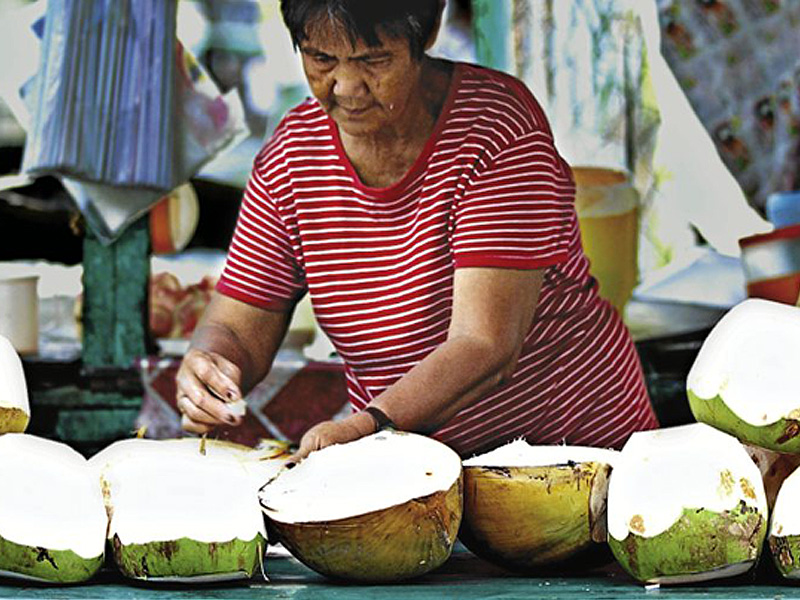
NATURAL PACKAGING . Coconut vendors in Lucena City expect brisk business after President Aquino noted after his arrival from the US on Friday that fit-conscious Americans are going cuckoo over coco water. DELFIN MALLARI JR./INQUIRER SOUTHERN LUZON
Mesmerized by the coconut juice craze sweeping the American market (mostly coming from other coconut-producing countries), President Aquino is encouraging Philippine companies to cash in on the fad.
The coconut industry, particularly representatives of the poorest farmers, are not exactly jumping for joy.  It is not hard to understand why, if we just spend a little time going a little  deeper than the surface of the economics of the coconut inbdustry.
But first a sound bite from the buko (young coconut) vendor that plies the streets with his cart (always a good place to start).  An enterprising television news channel had the journalist’s nose for news to seek out the vendor’s opinion on the President’s Aha! Moment, which is really the opinion that counts here. The vendor, speaking in Filipino, said he worried that exporting buko juice would drive up the cost of his buko from P10 to P15 apiece.
The beauty of street economics is that it is easy to understand—and is normally right on the button.  The poor man knows how much every peso is worth, for he can literally feel it in his gut.
It grows on trees
Now, for the more elaborate economics.  Joey Faustino, executive director of the  Coconut Industry Reform (COIR) Movement, says it is doubtful if the investments will benefit the “impoverished millions of coconut farmers and their families that comprise a third of the Filipino population.”
While on a working visit to the United States last week, President Aquino announced that two US companies—Pepsi Cola and Vita Coco—were planning some $15 million in new investments in the coconut industry to meet a growing international demand for coconut water.
The impact of the coconut industry on Filipino lives is staggering.  Fully a third of the population derives income from the industry. More than a fourth of the country’s total agricultural lands (or some 3.37 million hectares) are planted to coconuts, according to industry figures.
In Quezon province alone, some 304,000 farmer-families till 388,664 hectares of coconut lands. There are over 3.4 million farmer-families who depend on coconut.  Its effect on consumer purchasing power is so pervasive that San Miguel Corporation tracks farm gate prices to forecast beer sales.
When the harvest is good and prices are high, farmers consume more beer, considered a premium drink in the rural areas (not buko juice).  When prices are low, farmers shift down to gin, rum, or local spirits like lambanog, which is fermented from—you guessed it!—the sap of the coconut tree.
Economics of scarcity
The reason the industry is not overjoyed over the President’s good news is that there is actually a lack of coconuts to meet demand.  I know of at least one cooking oil company scrounging for raw material for its refineries, which are operating at less than efficient capacities.
The raw material is needed not only for making cooking oil, for which we can hardly supply international demand. Coconut also provides the raw material for dessicated coconut (coconut milk) and, more profitably, coco sugar, which is healthier than cane sugar, especially for diabetics.
Coco sugar will yield P14,000 per hectare per month, while dessicated coconut yields P8,000 and coconutoil (from copra) about the same, according to industry sources.
Economies of scale
Converting the land to palm oil may yield P12,000, but a minimum size of 25 hectares is needed to generate the economies of scale to operate a palm oil refinery efficiently, compared to an average five hectares for a coconut farm to be viable.
All told, the country does not have enough coconut trees to supply current demand for its products.  And because it takes anywhere from three to five years for trees to be really productive, the solution is to plant more trees now, not to sell more buko juice, industry sources say.
The story is told that while a sweltering Napoleon was marching his armies to conquer more territory for the French empire, he noted that his troops could cover more ground if the Romans had thought of planting more trees along the roads that led to Rome.  In the shade, Napoleon mused, the troops could march longer.  A lieutenant protested: “But, my general, it will take years to grow those trees!”
Replied Napoleon: “In that case then, we better begin planting now.”
Buko juice economics requires that first of all we must know how to use our coconut.

Thursday, October 13, 2011

Buko juice, anyone?


Buko juice, anyone?

By: 
 6share131 112
Buko juice. There is something uncanny about what P-Noy can sometimes say that goes straight to the Filipino heart, like “no wang-wang,” or “kung walang kurap, walang mahirap.” The intellectual who cannot reach below the surface will smirk at simple-mindedness, then is bewildered at the impact of simple phrases on the Filipino public. After all their attempts at learned diagnosis and prognosis, and their doomsday predictions about a president who doesn’t seem to understand governance, has no vision, and little political will, P-Noy gets the highest approval and trust ratings of any president after one year in office.
To cover criticisms he had aimed at P-Noy from during the campaign period to today, a well-known opinion maker says that Filipinos are too complacent and do not demand more from their leaders. That statement in itself is close to being absurd, and quite revealing about undisguised bias. The opinion maker conveniently forgot to accuse Filipinos of being too trusting as well – maybe because he knows that Filipinos are not. The survey was about approval and trust, and the people resoundingly said, “we approve, we trust.”
Buko juice is about buko juice, and way beyond. Just as wang-wang is about wang-wang, and way beyond. It is funny how the intuitive intelligence of Filipinos can, to the degree that surveys capture their truth at any moment, can appreciate the depth of what wang-wang means and what wang-wang represents, what buko juice means and what buko juice represents, but many a self-acclaimed media pundit can utterly miss. Or choose to miss in order to justify pursuing a losing line.
It sure seems clear to most that “utak wang-wang” is the “I am better-than-you, or richer-than-you, or more-power-than-you” and, therefore, am entitled to more than you. It means a few can break the law and most cannot; it means some can go ahead of the line anywhere, anytime, and most cannot. It means wealth, power and even high academic degrees and social pedigrees entitle the minority to lord it over the common, ordinary majority.
Thus, when future of the buko juice is the bacon that P-Noy brings home from America, his critics smirk. That their previous smirks have been dismissed by the people as sour-graping, as prejudiced conclusions, or as malicious accusations seems to be a reality too harsh for them to admit; they would rather believe that their opinions matter more than the sentiments of the vast majority.
Buko juice is that drink which must be the most common and readily available drink for Filipinos after water itself. Coffee has been on the rise, but the poor in the rural areas can count on having buko juice even in the fields where they work. A society that has long been governed by the little minority (very little, as little as 1%) will tend to look down on buko juice. That is why it is only recently in Philippine history that more attention has been given to buko juice when the elite had centuries to avail of it. Buko juice must have looked so low and ordinary to those who, from a long time ago, could afford cognac, chocolate, and coffee.
It may not have mattered much to societal snobs that coconut farmers and their families comprise a rather huge percentage of the Filipino population, and that Philippine lands are mostly planted with coconut trees. It matters little what most need, what most have, and where most are; what matters much is what the few want, what the few have, where the few are. Of course, what the few value more is what Philippine society has been following, at least for four hundred years. That does not make what the elite wrong all the time, but it does make them selfish when they have little regard for what the majority needs.
Buko juice is a product of, by and for tens of millions. That is why it matters to the majority. But the majority counts only in a true democracy. When the will of the few become more important than the sentiments of the many, there is no democracy in practice, only on paper. Democracy demands the will of the majority be the one that drives the vehicle of governance. And that will is as common, as ordinary, as buko juice.
Yes, the world has become very technical, very technological, and very viral. That means buko juice must find a way to adapt, to adjust, yet stage its own initiatives from its natural platform. That means Filipinos must lean on their own native talents and resources – then use these in the game of technology. At the same time, even the technically adept needs simple things in life, things they have often no time for, like bringing up their children because they are in their offices, like cleaning their houses because they are busy at work, likecooking their food because they have no time. Well, Filipinos still do all these chores, and more.
They are the healers of the world, the doctors and the nurses. They man the seas even when others have the capital to build the ships. Filipinos know how to make the rest of the world laugh, cry, sing and dance. And in a world that is turning to communications more and more, guess who will excel.
One day, the Filipino race will be a nation. It will finally become one people, one nation, when it discovers that the buko juice is more important as Coca-Cola. And the most pleasant offering of a host will be, “Buko juice, anyone?”