Showing posts with label natural gas. Show all posts

Tuesday, November 13, 2012

We’re sitting on a vast pool of oil in Palawan


By 


Why don’t foreign investors come to the Philippines in droves in spite of the fact that we have skilled and relatively cheap labor? Because it is difficult to do business in the Philippines due to corruption, red tape, clogged roads that delay the delivery of goods, and very expensive electricity—the most expensive in Asia after Japan. This last, in turn, is due to the expensive oil that we import to run our power generating plants. The hydroelectric and geothermal plants that are cheap and clean are no longer sufficient for the needs of our growing population and expanding economy.
Yet we are sitting on top of a pool of oil in Palawan. Why don’t we pump it out and use that? Right now, only Shell is pumping out a limited amount of oil—which it sells to us at the same price as imported oil despite the fact that we own that oil—and natural gas which is used by two power plants to generate electricity.
Alas, the administration has “officially” abandoned the extraction of oil from the Malampaya rim. That was the latest position of the administration based on the statement of an undersecretary of the Department of Energy (DOE) who said it is postponing indefinitely the bidding for the service contract related to the development of the oil rim in Palawan.
As former Leyte Gov. Jericho Petilla assumes the top DOE post, let us hope that the administration will take a more serious look at how much potential revenues, and savings in oil bills, we are losing with that decision.
It is ironic that the Philippines is moving heaven and earth, including risking a shooting war with China, in an apparent bid to help private contractors extract oil in the disputed Recto Bank in the West Philippine Sea. This is not to say that the government should not pursue its bid to tap the rich mineral resources in that area in spite of the conflict with China. What we are saying is that there is a proven pool of oil sitting idly inside uncontested Philippine territory and outside of any area where there are counterclaims from our neighbors.
The US Energy Information Administration, which noted that China has had no objections to the Philippines developing the Malampaya field, estimates that in 2008, there were 150 million barrels of oil there. Its view is that the recoverable volume may have dwindled, but at least 25 to 40 million barrels of oil can still be extracted from the field—that is, if our government moves quickly.
Crude oil in Asia hovers at around $100 per barrel. That means there is a buried treasure of black gold in Malampaya valued at $4 billion. That is oil we can extract anytime without having to go to war with a giant neighbor.
But it looks like there are two other “giants” we may have to contend with before Filipinos can benefit from that $4 billion worth of oil in Malampaya.
The first “giant” is the silent but clear opposition from international business interests operating the natural gas facility in Malampaya. Filipinos may have been left to believe for too long that the only energy resource available in Malampaya is natural gas. False.
The business interests operating the natural gas facility have long boasted that there are some 3.7 trillion cubic feet of proven natural gas reserves in Malampaya. But they have been silent on the presence of large oil deposits underneath the gas. Pumping out the oil would entail additional capital expense for them that would dilute their huge profits from the current natural gas production. So they have refused to develop the oil resources, to the disadvantage of the Filipino people who would have a share in this oil.
The other “giant” is the apparent refusal of this administration to pursue any idea, no matter how bright, if such an idea was first conceived during the previous administration. A newspaper report has also mentioned that the previous administration planned on extracting the oil but that the Philippine National Oil Co. apparently caved in under pressure and awarded the service contract to an unqualified group that was not able to deliver on the contract.
So as not to let that vast pool of oil go to waste, the government must bid out the service contract to develop the oil deposit to a qualified and legitimate oil production company. It cannot afford any more delay and should tell the current operator of the natural gas project to study and evaluate the economic feasibility of the oil deposit because it is this same operator that has adamantly refused to do its job by its contract and has deprived the government its just share in the value of the oil. The government is obliged to tap and develop that precious oil reserve for the Filipino people.
When Petilla’s appointment as the new energy secretary was announced, drum-beaters said he could stand up to any business interest because he is not indebted to them. The clamor to extract that oil from the Malampaya oil rim provides an excellent opportunity for Petilla to prove what drum-beaters say.
That oil deposit in the Malampaya oil rim will not be there forever. It is dwindling while we do nothing.
When in Cebu City, please visit http://www.gregmelep.com for your real estate and retirement needs. Avail of the opportunity to own a condominium unit in Cebu City together with your own parking space at the low amount of only P12,000.00+ and House and Lot @ P 7,306.81/month only. Hurry while supply of units still last. Just call the Tel. Nos. shown herein: (053)555-84-64/09164422611/09173373687.

Tuesday, April 17, 2012

Philippines may soon own vast gas-rich area


By 
r

share4613 4376

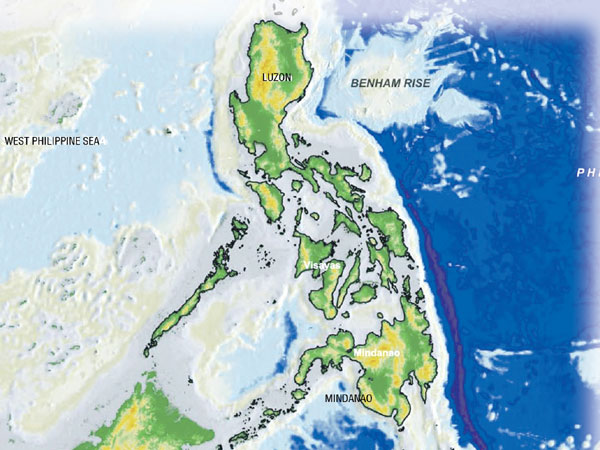
BENHAM’S RICHES The Philippines is the only claimant to 13 million hectares of an undersea region that contains huge natural gas deposits.
The Philippines will gain 13 million hectares in additional territory, an area slightly smaller than Luzon, should the United Nations approve next year the government’s claim on a region off the coast of Isabela and Aurora, Environment Secretary Ramon Jesus Paje said on Monday.
Paje said the undersea region, called Benham Rise, could turn the Philippines into a natural gas exporter because of the area’s huge methane deposits.
Studies conducted by the Department of Environment and Natural Resources (DENR) for the past five years indicate large deposits of methane in solid form, Paje said after a Senate budget hearing.
The government is only awaiting a formal declaration from the UN Convention of the Law of the Sea (Unclos) that Benham Rise is on the country’s continental shelf and therefore part of its territory, Paje said.
Legal basis
Once the Unclos establishes that Benham Rise is part of the Philippines, “we would have legal basis to enter into exploration agreements with private companies to explore… (the area’s) resources,” said Sen. Franklin Drilon, chair of the chamber’s finance committee.
Drilon said a favorable Unclos declaration would mean “increasing our territory from present 30 million hectares to possibly 43 million” with the inclusion of Benham Rise.
Discussion over Benham Rise generated excitement especially after Paje said that Philippine representatives were just awaiting one more meeting “to answer questions” before a special Unclos committee.
Only claimant
Paje said there was no reason for the Unclos committee not to issue a decision favorable to the country “since we are the only claimant, unlike in the western side (where the Spratly Islands are).”
“We have submitted a claim under (Unclos) sometime in late 2008. We got a reply from the UN lately (asking us) to answer some questions. They intend to pass a resolution sometime in mid-2012 to approve our claim (that it is) part of the Philippine continental shelf,” Paje told reporters after the hearing.
Records showed that the Philippines officially submitted a claim with the UN Commission on the Limits of the Continental Shelf in New York on April 8, 2009.
Davide submission
Hilario Davide, then Philippine ambassador to the United Nations, filed the country’s partial submission with the commission.
The United Nations says the continental shelf is “the seabed and subsoil of the submarine areas that extend beyond its territorial sea” up to 370 km (200 nautical miles) from the archipelagic baseline. An extended continental shelf goes farther than 370 km.
The Philippines claims that Benham Rise is an extension of its continental shelf.
Paje said Benham Rise was within the country’s 370-km exclusive economic zone.
American geologist
The environment secretary said an American geologist surnamed Benham discovered the area that was between 40 and 2,000 meters below the waterline in 1933.
“But we are able to define categorically that it is attached to our continental shelf only recently. We have proven (to) Unclos that it is attached. So now the UN is considering it for decision sometime in 2012,” Paje said.
He said gas deposits in the area would enable the country to achieve energy sufficiency.
“Benham Rise is very relevant because of its gas deposits (which has been) confirmed particularly by (the) National Mapping Resource Information Agency. It has given us the data that (the area) contains solid methane. We have not explored it but we have found nodules of methane in the surface and this is very important to us,” he said.
Kalayaan, Scarborough
The Kalayaan Island Group, which is part of the disputed Spratly Islands and Scarborough Shoal, both located in the West Philippine Sea (South China Sea) and claimed by the Philippines, are also believed to contain oil and natural gas.
Paje said there was the possibility that the country could export gas in the future.
The secretary added that there would be a demand for gas deposits in Benham Rise “because it’s much cleaner than (other) fossil fuels.”
The DENR formally submitted its proposed P16.99-billion budget for 2012 to the Senate finance committee.

Monday, August 22, 2011

Philippines may soon own vast gas-rich area


Philippines may soon own vast gas-rich area

By 
 89share2472 2303
BENHAM’S RICHES The Philippines is the only claimant to 13 million hectares of an undersea region that contains hugenatural gas deposits.
The Philippines will gain 13 million hectares in additional territory, an area slightly smaller than Luzon, should the United Nations approve next year the government’s claim on a region off the coast of Isabela and Aurora, Environment Secretary Ramon Jesus Paje said on Monday.
Paje said the undersea region, called Benham Rise, could turn the Philippines into a natural gas exporter because of the area’s huge methane deposits.
Studies conducted by the Department of Environment and Natural Resources (DENR) for the past five years indicate large deposits of methane in solid form, Paje said after a Senate budget hearing.
The government is only awaiting a formal declaration from the UN Convention of the Law of the Sea (Unclos) that Benham Rise is on the country’scontinental shelf and therefore part of its territory, Paje said.
Legal basis
Once the Unclos establishes that Benham Rise is part of the Philippines, “we would have legal basis to enter into exploration agreements with private companies to explore… (the area’s) resources,” said Sen. Franklin Drilon, chair of the chamber’s finance committee.
Drilon said a favorable Unclos declaration would mean “increasing our territory from present 30 million hectares to possibly 43 million” with the inclusion of Benham Rise.
Discussion over Benham Rise generated excitement especially after Paje said that Philippine representatives were just awaiting one more meeting “to answer questions” before a special Unclos committee.
Only claimant
Paje said there was no reason for the Unclos committee not to issue a decision favorable to the country “since we are the only claimant, unlike in the western side (where the Spratly Islands are).”
“We have submitted a claim under (Unclos) sometime in late 2008. We got a reply from the UN lately (asking us) to answer some questions. They intend to pass a resolution sometime in mid-2012 to approve our claim (that it is) part of the Philippine continental shelf,” Paje told reporters after the hearing.
Records showed that the Philippines officially submitted a claim with the UN Commission on the Limits of the Continental Shelf in New York on April 8, 2009.
Davide submission
Hilario Davide, then Philippine ambassador to the United Nations, filed the country’s partial submission with the commission.
The United Nations says the continental shelf is “the seabed and subsoil of the submarine areas that extend beyond its territorial sea” up to 370 km (200 nautical miles) from the archipelagic baseline. An extended continental shelf goes farther than 370 km.
The Philippines claims that Benham Rise is an extension of its continental shelf.
Paje said Benham Rise was within the country’s 370-km exclusive economic zone.
American geologist
The environment secretary said an American geologist surnamed Benham discovered the area that was between 40 and 2,000 meters below the waterline in 1933.
“But we are able to define categorically that it is attached to our continental shelf only recently. We have proven (to) Unclos that it is attached. So now the UN is considering it for decision sometime in 2012,” Paje said.
He said gas deposits in the area would enable the country to achieve energy sufficiency.
“Benham Rise is very relevant because of its gas deposits (which has been) confirmed particularly by (the) National Mapping Resource Information Agency. It has given us the data that (the area) contains solid methane. We have not explored it but we have found nodules of methane in the surface and this is very important to us,” he said.
Kalayaan, Scarborough
The Kalayaan Island Group, which is part of the disputed Spratly Islands and Scarborough Shoal, both located in the West Philippine Sea (South China Sea) and claimed by the Philippines, are also believed to contain oil and natural gas.
Paje said there was the possibility that the country could export gas in the future.
The secretary added that there would be a demand for gas deposits in Benham Rise “because it’s much cleaner than (other) fossil fuels.”
The DENR formally submitted its proposed P16.99-billion budget for 2012 to the Senate finance committee.