Showing posts with label PPUR. Show all posts

Monday, February 18, 2013

New online booking: It’s more fun on underground river tour


New online booking: It’s more fun on underground river tour

By 


 0 17 14

Travelers can now expect a smoother visit to the famous subterranean river in Puerto Princesa City with a new online booking system, a project launched by the Department of Tourism (DOT) in partnership with the local government.
MANILA, Philippines—Travelers from across the world can now expect a smoother visit to the country’s famous subterranean river in Puerto Princesa City with a new online booking system, a project launched by the Department of Tourism (DOT) in partnership with the local government.
In a statement issued Monday, the DOT said the online booking system was aimed at easing the traffic of tourists visiting the Puerto Princesa Underground River (PPUR) and avoiding confusion in securing permits from the PPUR office.
“Puerto Princesa City is a perfect example of a local government unit that works hand in hand with the national government,” said Tourism Secretary Ramon Jimenez Jr. in a statement on Monday.
“We in the department are enablers of tourism. The active participation on the ground is what makes things happen, as it is always done on the people’s behalf,” he said.
The DOT and the local government’s joint launch of the online booking system for the PPUR is just the beginning of their effort to implement measures that would help ensure that the world-famous attraction’s carrying capacity will not be compromised, said Jimenez.
Being named among the world’s new Seven Wonders of Nature last year, the 8.2-kilometer Palawan river has become a top tourism draw, recording an increase of 45 percent in arrivals since 2011, according to the DOT.
The tourism agency turned over the online booking system—which can be accessed through http://ppur.com.ph even by travel agencies all over the country and even abroad—to the city government on Feb. 7.
It noted that successful bookings will receive an e-mail notification, which will serve as a digital invoice that has to be printed and presented upon the visit to the PPUR.
For his part, Puerto Princesa Mayor Edward Hagedorn said he was optimistic the new system would result in “renewed fun” in the city and would help put in place a more efficient payment mode for visitors.

When in Cebu City, please visit http://www.gregmelep.com for your real estate and retirement needs. Avail of the opportunity to own a condominium unit in Cebu City at the low amount of only P9,333.33 and House and Lot @ P 7,306.81/month only. Hurry while supply of units still last. Just call the Tel. Nos. shown herein: (053)555-84-64/09164422611/09173373687.

Thursday, March 1, 2012

Big tourist bucks seen for Puerto Princesa Underground River


By 


 0shareNew 0

Puerto Princesa Underground River
PUERTO PRINCESA—With the skyrocketing popularity of the Puerto Princesa Underground River (PPUR)—especially after its official declaration as one of the new natural wonders of the world, visitor numbers may top 1.2 million by 2016, more than twice the number in 2011.
Scientific projections of the Puerto Princesa City Tourism Office show two million tourists checking out the PPUR by 2025, according to city tourism officer Rebecca Labit.
Labit said that in 2011, tourists to the PPUR numbered 500,146 and they spent P9 billion in Puerto Princesa.
The PPUR has become so popular Labit has advised visitors to book their rooms in advance as hotels are usually full and city officials have imposed a cap on the number of visitors who can go on the underground river daily.
“Book early so you would not be disappointed,” she said.
Labit said there were about 100 hotels, pension houses and inns in Puerto Princesa. All told, around 2,000 rooms were available and could accommodate 4,000 people.
The tourists number some 1,200 to 1,500 a day, she said. In the past, it got about 10 visitors a month.
According to Labit, the number of tourists coming to Puerto Princesa had been on a steady rise since the 1990s, especially after the underground river was declared a Unesco World Heritage Site.
But when the campaign to include the PPUR among the new seven wonders of nature began in 2007, the number of visitors skyrocketed.
From a rise of 18 to 20 percent in tourist numbers in past years, in 2010 this rose to 50 percent.
The increasing number of tourists has resulted in ever rising revenue for Puerto Princesa.
In 2009, total tourist receipts was P3.2 billion, in 2010 this ran up to P6.2 billion.
Last year it was P9 billion.
Labit said a tourist spends P4,000 to P5,000 a day in Puerto Princesa. She noted the cost of tourism in the city was higher compared to Hong Kong, for instance.

Sunday, December 25, 2011

The City in the Forest


By JOJIE ALCANTARA
Scene Stealer

MANILA, Philippines — Puerto Princesa, the capital and only city of Palawan, was historically named by Spanish colonizers after Princess Eulalia who was born in 1864 to the reigning Queen Isabel II and Dr. Francisco de Asis of Spain. After the princess died, the city was changed to Puerto de la Princesa, and eventually, Puerto Princesa as it is known today.
People also attribute the name for its strategic advantages – a seaport that is geographically typhoon-free and can accommodate every sea vessel protectively in its realm, hence, “a princess of ports’.
My excitement upon visiting this place was out of curiosity at first. I come from Davao City which has a lot in common with Puerto Princesa. Apart from both claiming to be the largest city in the country (Davao in terms of land area at 244,000 hectares, and Puerto Princesa at 253,982 hectares), these cities are also constant and proud recipients of Presidential Awards like the Cleanest and Greenest Highly-Urbanized City in the Philippines, among other accolades.
Puerto Princesa is teeming with lush dense forest, amazing and unique species of flora and fauna (I have read that Palawan was once connected to mainland Borneo millions of years ago, thus having a closer evolution to the wildlife of Borneo), even as it is the most progressive urban hub of Palawan. Imagine living the city life in an island tropical paradise setting, or as it is dubbed, “The City in the Forest”.
Puerto Princesa lies in the heart of Palawan and is the center of trade, commerce and industry in the province. Under the steady hands of Mayor Edward Hagedorn, it has become a model and example in cleanliness, ecotourism and preservation, peace and order and good governance. Far from being a huge metropolis, Puerto is laidback in lifestyle. It does not have taxis but multicabs and jeepneys for public transport, and private vehicles for hire. At that time, back in 2004, there was already a strict P200 peso fine for littering.
In a city tour, I was thankful for the van’s tinted glass, for I was almost reprimanded for taking photos inside the famous Iwahig Prison and Penal Farm, which was prohibited to protect the identities of prisoners.
Iwahig was established by the Americans in 1904 to house exiled offenders who were banished to the island. This “prison without walls” became a successful penal colony because it allowed detainees to roam freely, and live with their families. Disciplined inmates were taught to create handicrafts and souvenirs for livelihood, apart from cultivating rice and crops in the vast farm. Expect one or two inmates to quietly approach you and offer a bargain for their crafts. If not for their color-coded uniforms (brown for minimum security, blue for medium, and orange for maximum), they look like ordinary vendors who didn’t have a record to their names. Rarely was there an escape attempt, because of constant head counts and the difficulty of escaping from the island.
Memorable places to visit are the butterfly garden, crocodile farm and the Mitra ranch. We bought souvenirs from the Palawan Museum, like fascinating Anito wooden and terra cotta artworks carved by artistic out-of-school youths through “A Boar Land,” an arts program in Aborlan, Palawan to support their formal education. I bought a wooden choker with an oddly-shaped erotic figurine for Php150. Small trinkets cost Php50 and above, while chokers and necklaces cost higher. Large art decors and carvings are more costly at Php400 up. The queerer it gets, the more expensive it becomes.
While the city tour was fascinating, the highlight was still a day’s trek to the primary tourist attraction, the world renowned Puerto Princesa Subterranean River National Park. The navigable part of its river inside the 4,000-acre cave stretches 8.2 kilometers in length (five miles) before it drains out into the South China Sea. While Palawan has claimed this treasure to be the world’s longest underground river, the title was surpassed by Vietnam’s Son Trach underground river reaching seven miles in length. (Latest discovery in 2007, however, gave way to Mexico’s Yucatan Peninsula with an underground river estimated to be 95 miles long.)
The Puerto Princesa Subterranean River National Park is included in the UNESCO World Heritage List for being the only national park in the country with a thick tropical forest cover within the city. Its unique and outstanding merits have also earned for itself a nomination and ultimately became a finalist in the New Seven Wonders of Nature, becoming the Philippines’ pride and bet. The Department of Tourism and the government have been going all out in a campaign to make Puerto Princesa Underground River (PPUR) move its ranking to Number One among the New 7 Wonders of Nature exclusive list (joining the Amazon in South America, Halong Bay in Vietnam, Iguazu Falls in Argentina and Brazil, Jeju Island in South Korea, Komodo in Indonesia and Table Mountain in South Africa after a two-year vote among 28 finalists that concluded November 11 of this year).
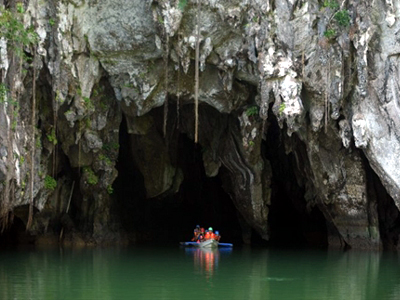
Located about 50 km north of the city of Puerto Princesa, the park features a limestone karst mountain landscape with an 8.2 km. navigable underground river. A distinctive feature of the river is that it winds through a cave before flowing directly into the South China Sea. It includes major formations of stalactites and stalagmites, and several large chambers. The lower portion of the river is subject to tidal influences. At the mouth of the cave, a clear lagoon is framed by ancient trees growing right at the water’s edge. Monkeys, large monitor lizards and squirrels find their niche on the beach near the cave.
We took a lengthy, rough ride by private van to Sabang town for two hours, passing through beautiful limestone and marble cliffs of Cabayugan. In Sabang, we rode small motorized boats for 20 minutes to St. Paul National Park, giving us glimpses of scenic mountain ranges, while coasting through emerald waters. After a short walk through a thick canopy of trees, we were accosted by monkeys who tried to rob us of our snacks. A lonely, huge monitor lizard ignored us nearby. We reached a quiet lagoon and put on helmets and life vests to start a two-hour underground voyage with a funny and entertaining boatman named Oteng.
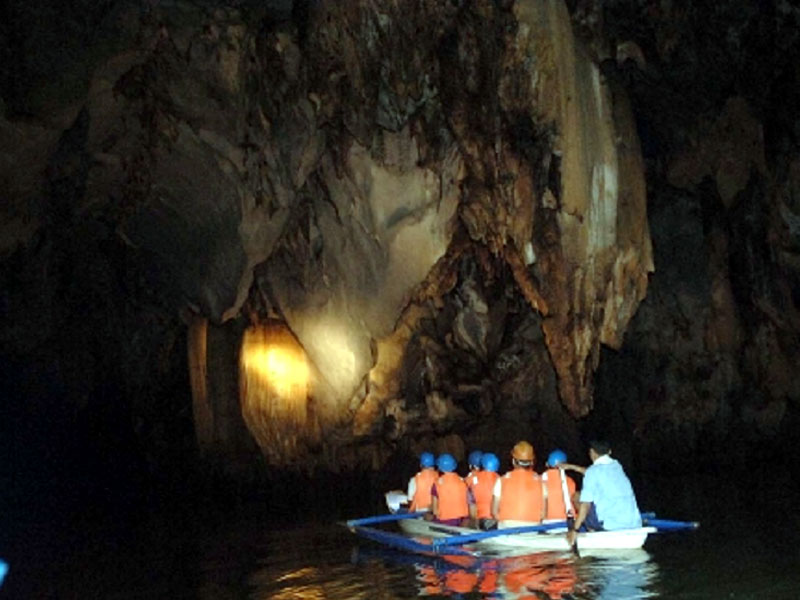
Darkness closed in on us once inside the spacious and dank cave. Natural ventilation provided cool air even as we went deeper into an abyss decorated with stalactites, stalagmites and chambers that were cathedral-like. Oteng, the cheery boatman began naming these uncanny natural rock formations as we passed by: a Holy Family tableau, St. Peter with a dog not a rooster, large vegetables hanging from walls, a sexy figure of a woman, two cats and genital patterns that made us laugh. Once, my helmet fell off because I stupidly looked up at the bats. We had to row back and retrieve it as it quietly bobbed in murky, silent waters.
This was not a good place for claustrophobics, by the way. Its eerie blackness and alternating narrow and wide passages will somehow consume you after 30 minutes, which is still halfway through the cave. The only light that shone was on the helmet of the boat’s first passenger. Whenever an interesting area was being pointed at, we waited until light would swing in that direction. I asked Oteng to hold the boat steadily so I could shoot various pillar statues in one spot, and he jokingly offered to drop me off and just come back for me later.
While we were a noisy bunch of Pinoys, we passed by boats with foreign passengers who were hushed and stiff as cardboard cutouts, apparently nervous of the pitch black journey. We laughed our jitters off and made jokes all the way back to the mouth of the cave, relieved when almost blinded by sunlight. The long but thrilling ride in those deep chambers was certainly worth the experience, more when your senses become attuned in the darkness. Your imagination runs wild at sudden noises around you. It doesn’t help when your boatman nonchalantly tells you, “Oh, it’s just a crocodile”. For the record, there are none inside that river.
Other destinations you can’t miss in Puerto Princesa are Honda Bay with its white beaches and islets including Snake Island and Dos Palmas Resort; the Immaculate Conception Cathedral, pristine waterfalls, enchanting lagoons, caves, mangroves and dive sites, Plaza Cuartel and the Vietnamese Village. Don’t forget to wine and dine in inviting places like Kalui Restaurant and Balinsasayaw Chicken Grill & Restaurant. Your special goodies, delicacies and pastries for pasalubong can be bought at  Baker’s Hill.
Air travel from Manila to Puerto Princesa takes an hour and a half and is available daily. Travel agencies are on hand to facilitate your trip arrangements. Hotels with good accommodation and reasonable rates are flourishing in Puerto. Getting around can be by tricycles, jeepneys or car rental services. Motorized outrigger boats can transport you to islands and beaches.
For more information, its official site is http://www.visitpuertoprincesa.com.

Monday, November 28, 2011

Nature's Wonder


By JIMS VINCENT T. CAPUNO
Going out of the cave
MANILA, Philippines -- One of the top natural attractions in the Philippines.  An excellent scenic spot to visit. A spectacular limestone karst landscape with its underground river.  These are just some of the words used to describe the Puerto Princesa Underground River (PPUR).
Actually, the amazing subterranean waterway is part of the larger Puerto Princesa Subterranean River National Park, which was established in March 26, 1971.  The National Committee on Geological Sciences declared the place as a National Geological Monument on December 11, 2003. Earlier, on December 4, 1999, the United Nations Education, Scientific, and Cultural Organization (UNESCO) designated it a World Heritage Site.
“The focus of the area is a spectacular karst landscape which features both surface karst as well as an extensive underground river system,” said UNESCO in a statement. “A distinguishing feature of the river is the fact that it emerges directly into the sea, and that the lower portion of the river is brackish and subject to tidal influences.”
Until the discovery of an underground river in Mexico’s Yucatan Peninsula in 2007, the  8.2-kilometer long Puerto Princesa Subterranean River was reputed to be the world’s longest underground river.
The underground river is approximately two kilometers south-west of Mount Saint Paul at an altitude of 100 meters.  The subterranean river is the park’s main calling card, and it passes through a mystical limestone cave before emptying out into the South China Sea.
No one knew who discovered the underground river first.  However, it is believed that the island’s early inhabitants were the first to know of its existence, but their fear of spirits that they believe inhabit the caves prevented them from exploring the cave.
The earliest recorded mention of the underground river was done by Dean C. Worcester, Assistant Professor of Zoology at the University of Michigan who later became the Secretary of Interior.  In 1887, he wrote while touring the island of Palawan that he heard of some accounts telling him “of a lake opening to the sea by a Subterranean River.”
The underground river is about 50 kilometers north of the city center of Puerto Princesa.  But be warned: you will need to spend about two hours of bumpy ride to get to Sitio Sabang, the starting point.
From Sitio Sabang, you have to ride a boat that can accommodate six to 12 persons. All visitors are requested to wear a life jacket as the boat ride of about 15 to 20 minutes can be quite tumultuous. Entrance fee is 200 pesos for foreigners and 150 pesos for locals.  Kids and senior citizens get a discount.
Be sure to listen to your bangkero as he explains the beautiful images of stalactites and stalagmites.  In the massive cavern called the Cathedral, you get to see an image of the Virgin Mary and the Holy Family.   There are several other images: corn, mushroom, carrot, jellyfish, umbrella, man’s head and parts of dinosaurs and ship.  A battery-operated lamp beams on these various formations.
When admiring the limestone cave and different formations, keep your mouth closed. The cave is home to bats and swiftlets, in which case guano often falls from the upper reaches.  Always wear your safety helmet because you’ll never know if it’s water or the pee of the bat that hits you.
On a busy day, the river receives about 800 visitors and about 600 visitors on lean days.

Wednesday, November 23, 2011

PAL to use bigger jets to boost underground river tourism


By 
er

 4share73 67
MANILA, Philippines—National flag carrier Philippine Airlines has vowed to promote the Puerto PrincesaUnderground River (PPUR)—now included in the provisional list of winners in the recently concluded online global search for the new Seven Wonders of Nature—by using bigger jets to bring in more tourists.
This is apart from PAL’s promotional activities in the Philippines and abroad, said airline president and chiefoperating officer Jaime Bautista.
“In support of  Puerto Princesa Mayor Edward Hagedorn’s program to attract more tourists, we will fly our bigger planes to Puerto Princesa,” said Bautista in a statement, adding that PAL was teaming up with the city government to maximize the tourism potential of the PPUR.
He said PAL would deploy wide body jets like the Airbus A330 to Palawan to accommodate the expected influx of tourists to the city after its underground river won global recognition.
At present, PAL flies twice daily to Puerto Princesa using an Airbus A320.
Hagedorn said the interest of tourists, both foreign and local, in the underground river had been greatly aroused by its new-found international fame.
Bautista said Palawan’s underground river was included in the top six destinations in PAL’s 2012 corporate calendar.
“This is how important PAL regards this wonderful destination,” he said.
Timely renovation
According to Bautista, the recent’ renovation and expansion of the Puerto Princesa airport was timely as it could now accommodate bigger aircraft.
Aside from the Puerto Princesa airport, other provincial airports that can accommodate bigger aircraft are those of Cebu, Davao and Iloilo.
Earlier this month, the PPUR was named one of the new Seven Wonders of Nature, along with the Amazon rainforest, Vietnam’s Halong Bay, Argentina’s Iguazu Falls, South Korea’s Jeju Island, Indonesia’s Komodo, and South Africa’s Table Mountain.
Hagedorn, for his part, credited PAL with helping develop and boost Palawan’s tourism industry. He said that back when Palawan was considered a missionary route, PAL was already flying to the island.
He noted that there used to be only two to three flights a day to Puerto Princesa. Now there are 11 flights a day, unloading not only local residents but mostly foreign tourists.
Last year, around 425,000 tourists visited the underground river. The city government expects some 550,000 visitors this year.
Already a Unesco World Heritage Site, the underground river is located in Barangay Sabang, 81 kilometers north of the city.
Longest in Asia
Also known as the St. Paul or Puerto Princesa Subterranean River National Park, the underground river runs 8.2 kilometers inside a limestone mountain. It is believed to be the longest underground river in Asia. While navigating the underground river, one can see formations of stalactites and stalagmites that had developed over 20 million years.
Known as the Philippines’ last biodiversity frontier, Palawan also has white-sand beaches, lush forests, wildlife parks and other natural wonders.